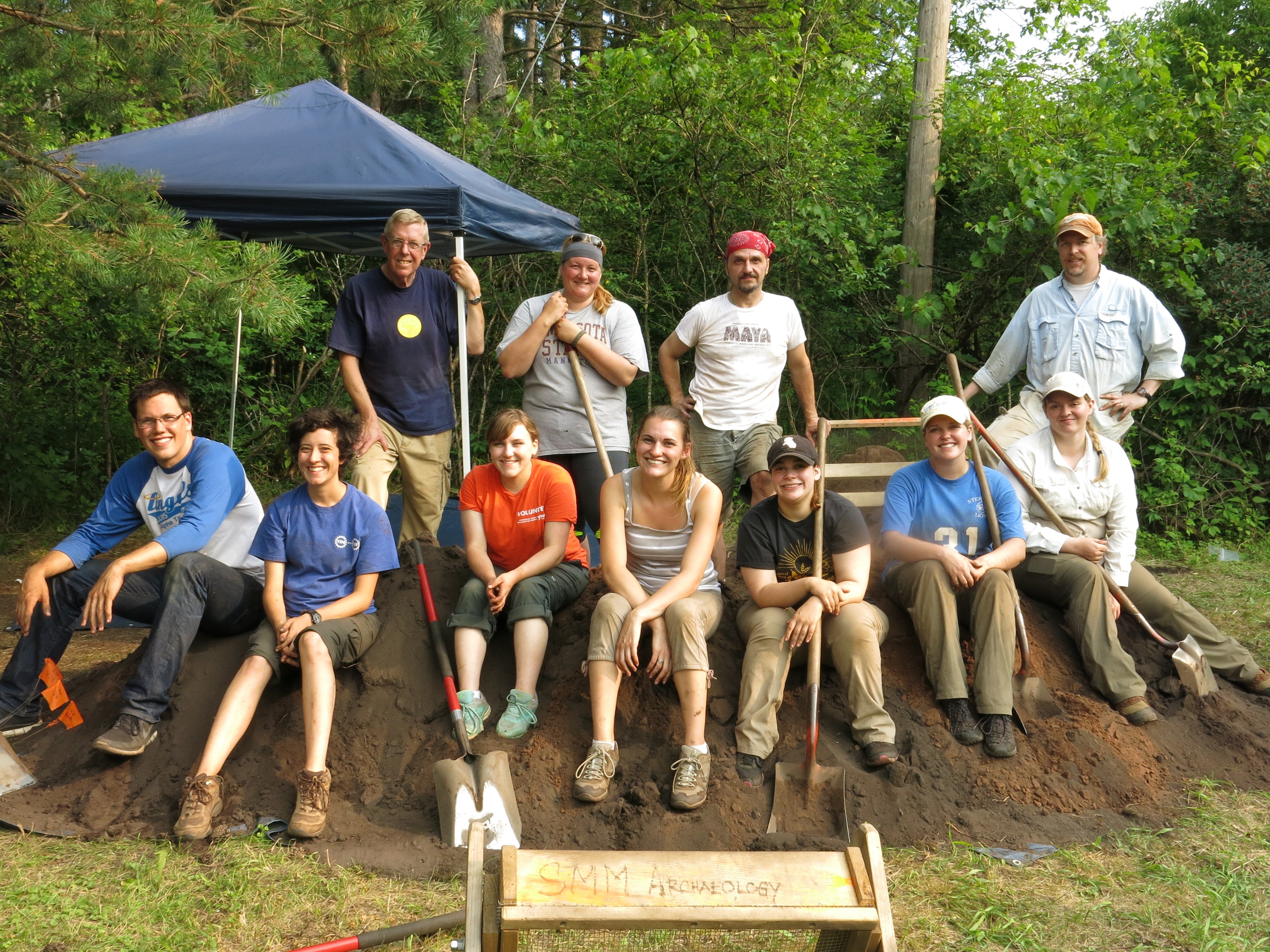
Every summer for well over a decade, Dr. Ed Fleming sends a new group of students out into the field — trowels in hand, questions in mind — to get real, hands-on experience at an archaeological dig site. But, what happens after the dust settles and the season wraps up? Where do those experiences lead?
In the spirit of curiosity, we reached out to some of our past participants to find out what they’re up to now, whether Archaeology Field School nudged them toward a specific career in science, and what still reminds them of their time out at the dig.
Below are their responses, in their own words.
Ellie Heaton, Analyst, Native American Graves Protection and Repatriation Act (NAGPRA)
“I am on the NAGPRA team for the University of California, Davis. I repatriate archaeological and ethnographic collections to tribes throughout California and elsewhere in the US. The Science Museum Archeology Field School was my first hands-on experience working in North American and Native American archaeology. It influenced me to become a CRM field tech and eventually get my master’s in Heritage Studies and Public History with an emphasis in Archaeological Heritage. I use the techniques I learned in Field School to better understand the background of archaeological collections in order to prepare them for repatriation. I also use the archaeological collections techniques learned in the Science Museum lab when I do collections work most days at my job.”

What’s on your desk right now that makes you think of Field School?
“I have some site and unit maps on my desk from an excavation in the 1990s, and I hope the drawings we did back in 2015 were clearer than these!”
Ruth Pardini, Assistant Stockroom Manager, Chemistry Department at the University of St. Thomas
“I’m support staff in the Chemistry Department, so I do most of the prep/setup work for teaching labs and help with other work that supports teaching and research.”
“In a roundabout way, [Field School] helped me professionally network and connect me with my current job. I met Ed when he taught two courses I took in college, and I enrolled in Field School the summer after I graduated. Ed invited the Field School students to volunteer in the [museum’s] Anthropology Lab to catalog the artifacts we excavated, and then I became more curious about museum work, then I got a job in the galleries. While working there, I met a volunteer named Carolyn who was working in the position I currently have. A few years later, she got a promotion, and I applied for her old job. Long story short: Field School allowed me to connect with people who were passionate about science education.
Overall, Field School gave me a deeper appreciation for archaeology and museum work. Working on the dig site and in the anthropology lab gave me a glimpse of the work it takes to find, clean, and catalog a single artifact from a single site. It also has left me with an enduring curiosity about the human history around me. I live in South Minneapolis, and within five miles of my house there are numerous sites that are significant for the Dakota people (Minnehaha Falls, Mni Owe Sni, Bdote). I walk my dog along the Winchell Trail at least once a week, and I think about something Ed said at Field School (and I’ll paraphrase): A good campsite today was probably a good campsite a thousand years ago. There are a lot of places that look like nice campsites along the river.”

What’s on your desk right now that makes you think of Field School?
“There’s a mug full of nice, ultra-fine-point sharpies that I would have loved to use out in the field, then immediately clog with dirt and lose in the grass.”
Scott Tooker, Archaeologist, Minnesota Department of Transportation’s Cultural Resource Unit
“I work on the Minnesota Department of Transportation’s Cultural Resource Unit as an Archaeologist. On behalf of the Federal Highway Administration, we review MnDOT-led and locally led transportation projects for compliance with Section 106 of the National Historic Preservation Act. We also review MnDOT projects and permits for state-level compliance. This includes: the Minnesota Historic Sites Act, Minnesota Private Cemeteries Act, and Minnesota Field Archaeology Act.
I took Dr. Fleming’s Field School in the summer of 2012, and it was a huge influence on my career! Prior to this experience, I had never stepped foot on an archaeological site. Our work taught me how to dig a shovel test transect, map out site boundaries, excavate a formal test unit, identify archaeological artifacts in the field, and properly document artifacts and features. Most importantly, I learned that I enjoy working in the field of archaeology!
From Field School, I had an avenue to volunteer in the Science Museum’s Archaeology Lab and next season’s dig. This volunteer work played a direct role in landing my first paid cultural resource management job working in the private CRM sector. Over the years I worked at several private firms, the US Forest Service, Minnesota Historical Society; obtained a Cultural Heritage and Resource Management Master’s degree from the University of Maryland; and landed my current job at MnDOT. Dr. Fleming’s Field School was an amazing opportunity to start a career that I love. I definitely credit his mentorship, along with the rest of the UMN staff, with the success I’ve had in my career!”
Do you have a favorite memory from Field School?
“During unit excavations, our unit’s team was listening to the “Epic Movie Soundtracks” Pandora station (remember, it was 2012!). The theme song for Indiana Jones comes on and just as it is beginning Dr. Fleming crests the small rise separating our unit from a separate excavation unit. It couldn’t have been timed any better! As he arrived at our unit, Dr. Fleming simply remarked, ‘I like to make an entrance.’”
Peter Niemczyk, Graduate student, Anthropology Department at UW-Milwaukee, focusing on Mississippian ceramics in the American Bottom
“My Field School experience cemented my interest in Midwestern pre-contact archaeology and archaeological fieldwork. Ed and museum staff also gave me the opportunity to work with materials from Pine Needles for my senior capstone project, providing me with a strong foundation in artifact processing, curation, and archaeological research. After Field School and graduation from the University of Minnesota, I went on to work in CRM in Hawai‘i and Minnesota before beginning graduate school in 2025. My thesis project focuses on Mississippian ceramic vessel production in the American Bottom.”
If you could dig up anything, what would it be?
“I’d love to work on excavating a late pre-contact pit feature somewhere in the Driftless Region of MN/WI.”

Kyle Lundin, Archaeologist, Minnesota Historical Society (MNHS)
“I mostly work with the archaeological collections here at MNHS, and every once in a while I get sent out for fieldwork. Ed’s Field School really solidified that I actually wanted to be an archaeologist, and it reassured me that all the hard work I put into my higher education was worth it. It made me appreciate how much I loved the things involved in archaeology, like working outside, as well as preserving cultural history and physical landscapes. After the Field School, I got the chance to volunteer with the gang at the museum. There I gained significant experience in lab procedures and working with museum collections that have helped me get to the position I am in today!”

If you could dig up anything, what would it be?
“I might choose artifacts from some kind of pre-Christian Scandinavian village/trade center site, like Birka in Sweden. I am fascinated by trade in that era so finding a cache of glass beads or other trinkets traded from Baghdad or somewhere far away would make my career.”