Every month, the Microscope highlights one object from the museum’s collections well-known and well-loved among our scientists for its uniqueness, historical significance, and complexity. Dr. Alex Hastings, Fitzpatrick Chair of Paleontology, chose this month’s selection.
Avid dinosaur fans are likely familiar with Ankylosaurus, the heavily armored dinosaur with a big club tail. Dedicated fans may also know its cousin, Euoplocephalus, an armored herbivore with bony spikes and a club tail.

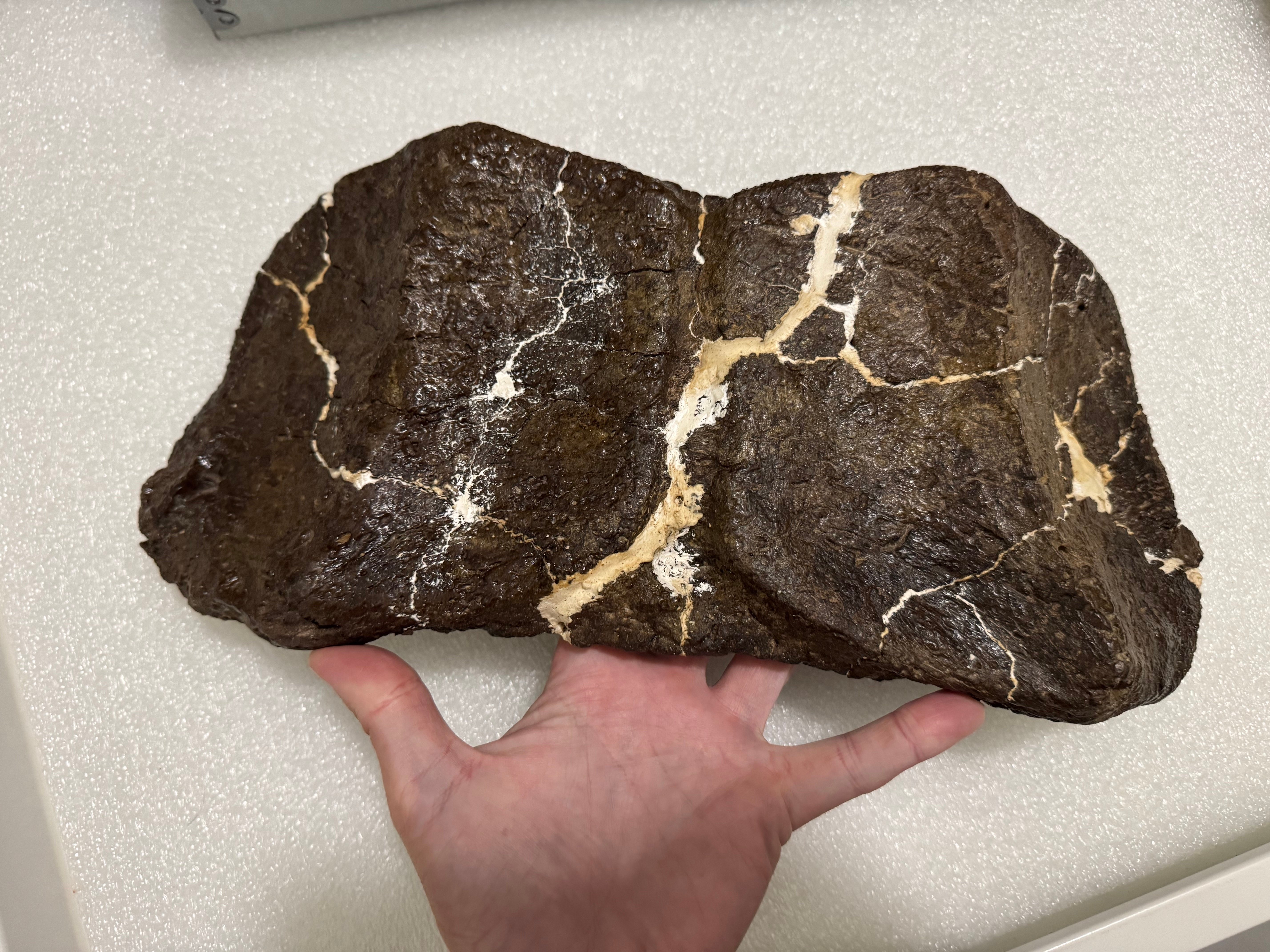
For this Object of the Month, we’re highlighting a vital piece of armor for this tank-like dinosaur that lived about 77 million years ago in what is now Alberta, Canada. This was found by the museum’s own Bruce Erickson, a paleontologist and curator at the museum for more than 58 years. It was found on July 12, 1967, in the southern part of Alberta during one of his expeditions to the area in search of dinosaur bones.
This is one of many plates that actually grew within the skin of the dinosaur along its neck and back, not actually attaching to the skeleton at all. A few other types of dinosaurs had these too, as well as all living crocodilians. They serve as protection for the vital organs against attacks from large carnivores.
As a herbivore, Euoplocephalus had to contend with some pretty big predators, including Gorgosaurus and Daspletosaurus, two types of tyrannosaur. In addition to heavy armor, Euoplocephalus had a sizable club on the end of its tail that it could swing at attackers, making it even more difficult to take down.
Specimen is SMM P68.48.1