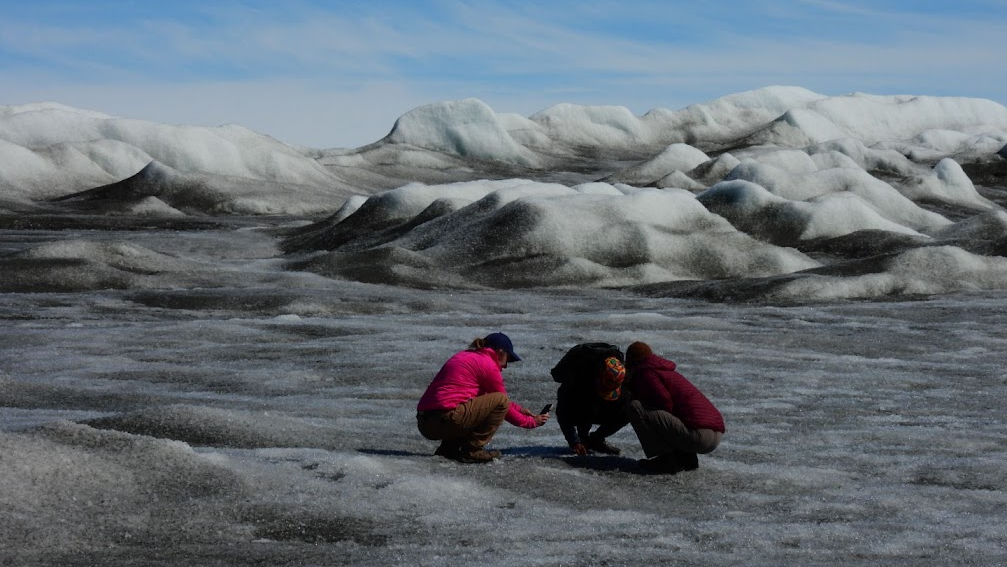
Recently, Dr. Adam Heathcote, Senior Director of the museum’s Department of Water and Climate Change; Dr. Lienne Sethna, Associate Scientist at the St. Croix Watershed Research Station; and Jill Jensen, a STEM Education Specialist at Parkview Elementary in District 196 traveled to Greenland to study how Arctic lake ecosystems are rapidly changing as a result of extreme weather events. This 10-year project, a collaboration with researchers from the University of Maine, aims to determine the causes for the rapid browning of lakes in western Greenland — and potentially predict how they will evolve in the decades to come. The Microscope caught up with the researchers after their return, and this post contains excerpts from that interview. Some responses have been edited for brevity.

Describe the project. Why did you go to Greenland? What was the purpose of being out there?
Adam: In 2023, a colleague of mine at the University of Maine came back to this area of Greenland which we have been studying for the last 15 years and observed something very surprising. All of the lakes which had been clear — what we call blue lakes — had, in the course of the previous year, shifted, to deeply stained brown lakes, kind of like the lakes we think of in northern Minnesota, where there’s lots of wetlands draining into them. Not what you would expect in this area! This is a natural process that lakes undergo going from blue to brown. But in general, this would take maybe a thousand years or more. So to have it happen in a year or less was really surprising and has been attributed to high temperatures and rainfall, well above average conditions. I don’t know of any other documented cases of this phenomenon happening this quickly.
There is a lot of research in the Arctic and the boreal forest investigating what’s called “brownification” of lakes. Lakes are slowly getting browner as the planet warms and other changes occur in the atmosphere. But this is over decades, not in a single year.
So, one of the foundational questions is are these lakes going to recover? Are the lakes going to go back to how they were before or are they going to go off into a whole new state and then just be basically stuck there for hundreds or thousands of years into the future? This is what this study is really designed to test. We’ve just started a 10-year National Science Foundation study, which is about three times as long as your average research project and that will give us the ability to track if and how these lakes recover and their capacity to resist future change.


Jill, what will you be bringing back to the classroom from your trip?
Jill: I’ve been both a seventh grade life science teacher and now my current role is a general STEM teacher for K-5 students. So a lot of the work I do is trying to get to the interdisciplinary nature of science and that it’s not in these silos. I feel like this was a perfect example of how science isn’t siloed and how all of these things are really connected. The work that this team is doing is so broad and covers so many areas and requires knowledge and the interaction between all of these components that are really affecting this one piece.
It was probably halfway through I told Lienne I should be getting college credit! I knew I was going into lake sampling and that was kind of the basics of it… I have a huge increase in my understanding of what that actually means. I teach about biology, geology, and chemistry of [lakes]. But to see that firsthand and really how those all play together was new.

I’ve told people Greenland was never really on my bucket list of places to go, but it was just one of the most beautiful places I feel like I’ve seen. It was just this surreal experience. Many of the lakes we visited were not accessible through any sort of trail. So it was crosscountrying across hills and valleys and tundra. It just was awe-inspiring to see a landscape that was so wild and untouched and beautiful.


Adam: One of the things that stuck out to us [about Jill] was that she had a lot of experience as a science teacher, but she also had experience in the science teaching community as the president of the Minnesota Science Teachers Association. So one of the things we wanted to do was get the word out of this program and also that the Science Museum has opportunities to include teachers in research, and we thought Jill would be a perfect person to do that.
Jill: I think, for me, my other really exciting piece is just being able to bring real life science data from a real research project to both students and to teachers. I think there’s times when data that kids get to experience or manipulate is very canned, so everything ends up perfect and your bar graph makes this nice trend. So to be able to show real data in real life, and show that there are people doing science today and show that science is not this settled thing that’s over and done with.
Adam: That for me is what is most exciting about this. It’s one of the first projects I’ve worked on where I have no idea what the end result is going to be. Ten years away seems so far, and we’re investigating something that no one has ever seen.
Jill: I think there’s some misconception sometimes by students that they’re learning already established facts instead of processes and ongoing research.
What was training like? What did you do to prepare?
Lienne: Well, the biggest thing was being able to hike or run even with a heavy backpack.
Jill: I would walk with a 20-pound pack at Lebanon Hills Park. I do still wish I had put more in and done more hill work.
Lienne: Then there were the weird body positions like sampling over the side of a boat! It’s like holding a weight on an extended arm while you’re leaning backwards.
Adam: There is no way to simulate exactly what you’re going to do, and what I find is the most difficult part is the ankle strength because you’re on the most uneven terrain that you can imagine. There isn’t anything like it in Minnesota.
We walked on these bowling ball-type objects called tussocks. It is like root systems that often grow on boulders that form balls, and they’re just a whole field of them. Most of the time you can just walk over the top of them, but sometimes there’s a gigantic hidden crevice and you can almost fall in like I did at one point.

What was your favorite meal?
Lienne: Oh my gosh, the hot dogs.
There was this market, but it was really the back of what seemed like an abandoned building. In the basement, no windows. There was a fast food counter where you could get chips and beer, and I think that’s it. But we would get these Danish-style hot dogs with a remoulade, pickles, diced white onion, and crispy onion. So, we would often have that as an immediate field snack before dinner. An appetizer, if you want.
Adam: We had a musk ox-stuffed musk ox which I thought was very impressive.
Jill: I had a musk ox burger the size of my head.
What was your favorite animal that you saw?
Jill: I have to go with the musk ox. It looks like you just want to curl up next to it and take a nap. [Editor’s note: Adam says you should definitely NOT do that.]
Adam: I like seeing the musk ox too.
Lienne: Loons and mallards!

What are you looking forward to when you return next year?
Adam: There will be a new teacher [joining us]. I’ve really enjoyed working with Jill because she forced us to slow down. Not that she slowed us down, but she would ask questions and so we’d have to stop and think about why we are doing this. What does this mean? So we would take the time to explain things, which I think was good so we all have a common understanding of our purpose.
Lienne: So all of the lake names are numbers that are not at all intuitive. Like lake2 is really close to lake 1590 which is really close to 1381 and….8. They’re not in order. I’m looking forward to just being able to not have to catch up so much in terms of keeping up with the conversation!

What connections, if any, can you make between the research in Greenland and Minnesota?
Adam: One of the reasons that scientists are interested in studying lakes in the Arctic is that as the most rapidly warming place on the planet, it is a test case for how ecosystems are going to change all over the planet. The closest analog to the Arctic is the boreal forest, which is [found in] northeastern Minnesota. So we can get an idea of what to expect because the impact on physics of how lakes work is identical whether you’re in the Arctic or in the boreal forest. The only difference is the rate of change that they’ve experienced to date. So, we can take a lot of those lessons that we’re seeing in these lakes, even though we’re in a completely different biome here, we can use them to predict how our lakes are going to change in the next 10 to 50 years.
I think we’ll learn a lot about how the systems work and be able to apply that to everything from boreal and temperate lakes to grasslands and forests because they’re all ecosystems. They all have similar components. There are just different pieces in different areas.
Lienne: I agree that there are things we will learn in the Arctic that are relevant to Minnesota, but I also want to expand and maybe push back and [say] that we need to care about things that are different from us. The Arctic is similar to Minnesota in a lot of ways, and it’s different from us in a lot of ways, but it’s broadly important in our global Earth system and how we’re going to be experiencing and dealing with climate change in the future.
Adam: It can be difficult to communicate scientific research on climate change to the public because of the doom and gloom that surrounds it but there is also hope that we can find resilience in ecosystems and systems in general. This is something that we as scientists should be focusing on because change is happening. That’s undeniable. But how are our political, ecological, environmental systems going to withstand, reverse, or be resilient to that change?