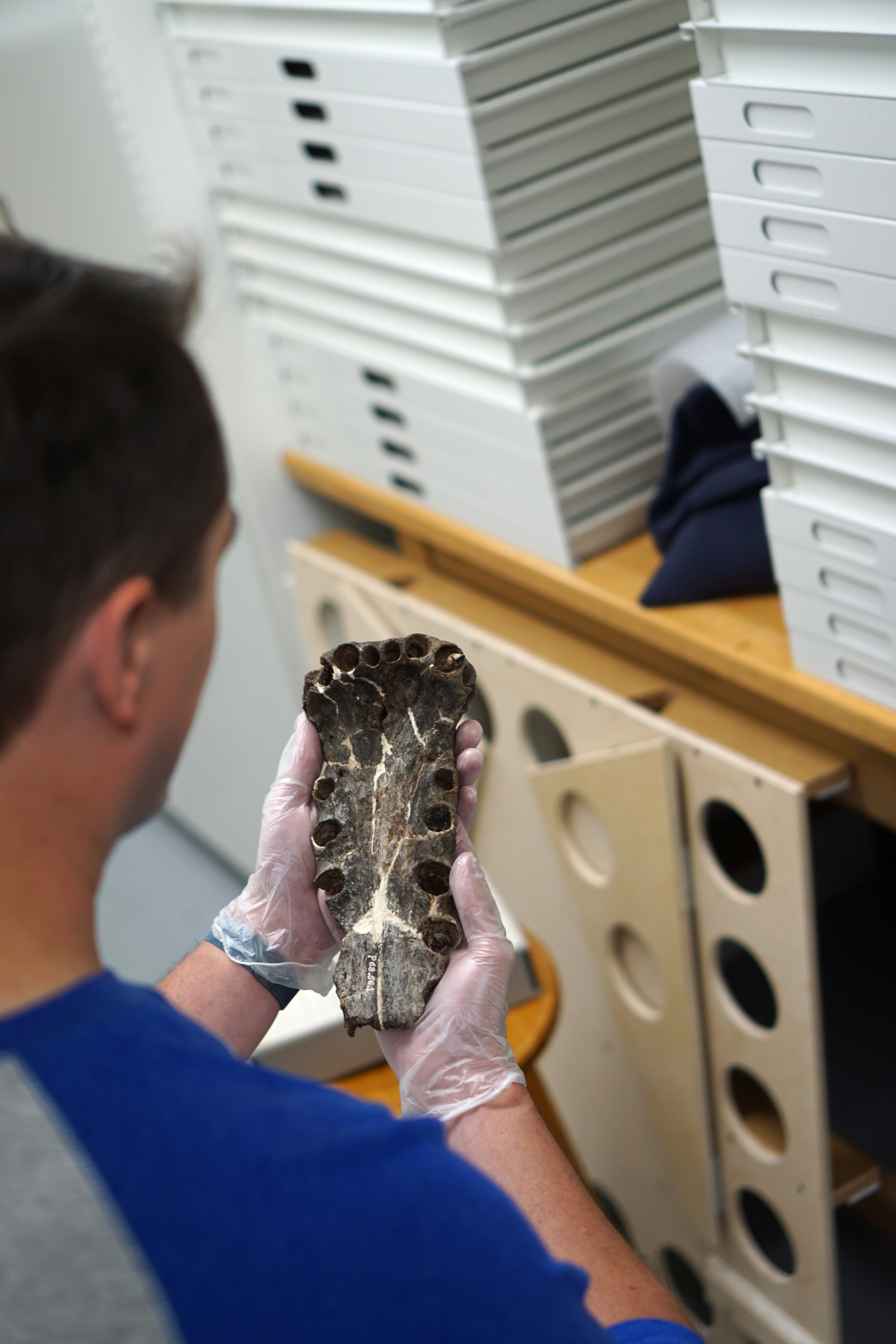
Recently, the Microscope had a conversation with Dr. Alex Hastings, Fitzpatrick Chair of Paleontology, about the Paleontology Department’s work and impact. This post contains excerpts from that chat.
For many scientists, dinosaurs started it all. Creatures so massive, and utterly unlike anything walking the Earth today, present a phenomenon that is almost beyond conceivable thought. However, what makes paleontology truly powerful is just childhood wonder. It’s understanding our planet’s past to navigate its future.
Maybe only one in a thousand kids who obsess over Triceratops actually becomes a paleontologist. But the other 999 become voters who understand evolution, parents who value scientific thinking, citizens who can evaluate evidence and make informed decisions. The T. rex poster on a seven-year-old’s wall is planting seeds of scientific literacy that can influence everything from healthcare choices to climate policy.

Dinosaurs offer something uniquely valuable: They help us grasp the vast, almost incomprehensible scope of Earth’s history. They remind us that our existence is a blink in geological time, that dominant species can rule for hundreds of millions of years and still vanish, that nothing — no matter how successful — is permanent. But, comfortingly, the knowledge we secure in our time can be shared and built across generations. Researchers, including our own scientists, access the collection we hold to add to the whole of human knowledge.
Among our museum’s treasures, the findings from Wannagan Creek stand out as one of the most requested fossil collections by researchers worldwide. It captures something rare: a complete ecosystem from right after the dinosaurs disappeared. 66 million years ago, an asteroid slammed into Earth. The age of dinosaurs ended. The Wannagan site in North Dakota preserves the time that followed in exquisite detail via fossil fungi, early primates, turtles, plants, and insects. This single collection generates more publications than any other subset of our holdings, and researchers keep finding new stories to tell from it.

Another item of particular note is the museum’s juvenile Diplodocus skull. Only a handful exist in the entire world, and ours is one of the few preserved in three dimensions rather than crushed flat. Why so rare? These massive sauropods had surprisingly delicate skulls small enough to fit on your desk. They were so light and fragile that they almost never survived fossilization intact. Our specimen came from years of patient fieldwork in Wyoming, discovered in an area where the overlying rock pressure from 150 million years was just light enough to preserve its three-dimensional structure.

Here at home, we also have an incredible paleontological story, and we’re working to share it through our state fossil initiative. Where our museum now sits, the landscape has transformed dramatically over geological time. Sometimes it was an icy grassland next to massive glaciers. Other times, it was a warm shallow sea, with tens of feet of water covering where our exhibits are now. When Indigenous peoples arrived here as early as 12,000 years ago, they encountered creatures we can barely imagine — giant beavers the size of black bears, among other megafauna now vanished forever. Now enshrined as our state fossil, the giant beaver is on view in the museum as a reminder of these ancient times.
These facts, unearthed through paleontology, are proof that environments change, species adapt or disappear, and the Earth we think of as stable is actually in constant flux. This is where paleontology becomes more than fascinating. Climate change isn’t a future threat; it’s already reshaping the natural world in measurable ways. Pythons and alligators have moved northward in Florida over just the past 50 years. Disease-carrying insects are expanding their ranges, bringing serious implications for crops and human health. Bison are physically shrinking as rising temperatures make it harder for their large bodies to shed heat, already affecting meat yields for those who harvest them.
Earth has been hotter before — much hotter. But the current rate of change is unprecedented, and that’s where paleontology offers crucial insights. Take Titanoboa, the massive prehistoric snake discovered in Colombia. Its existence proved that tropical regions got far hotter in the ancient past than climate models had predicted, fundamentally changing our understanding of what extreme temperatures make possible. If it got that hot once, it raises the bar for what could happen again, potentially enabling larger reptiles, broader ranges for disease vectors, and ecosystem shifts we’re only beginning to imagine.

Understanding these species-specific and region-specific responses helps communities prepare and adapt. This is particularly relevant here in Minnesota as people work to reintroduce bison, animals with profound cultural and ecological significance that once shaped these landscapes.
Paleontology studies more than three billion years of life on Earth. We’re not just looking backward; we’re using the past as a laboratory to understand the fundamental rules of how life works, how ecosystems respond to stress, and what resilience really means on a planetary scale.
So yes, dinosaurs are awesome. But they teach us to think across deep time, to recognize patterns in how life responds to change, and to understand that we’re part of a story far bigger and stranger than we typically imagine.