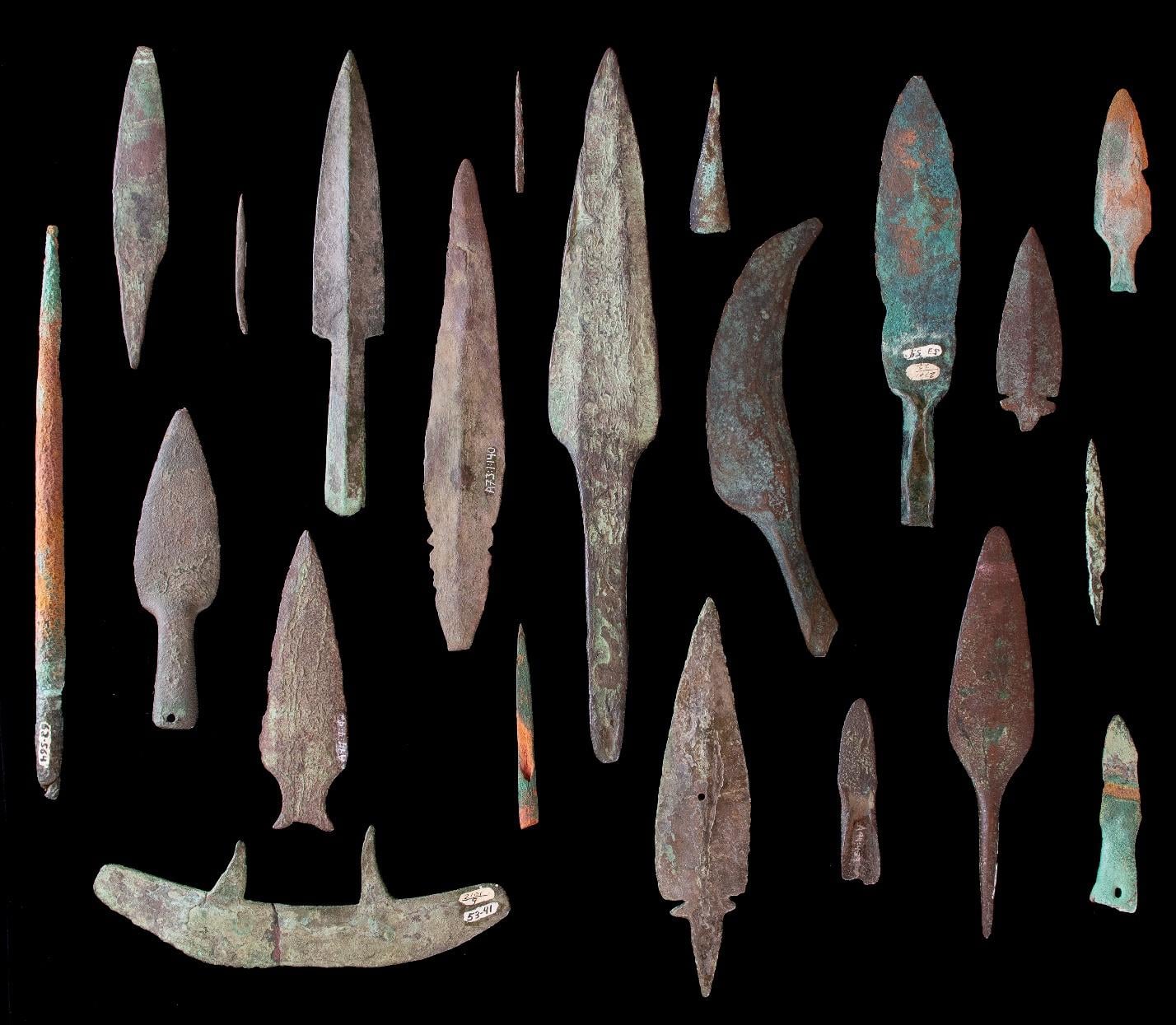
Every month, the Microscope highlights one item from the museum’s collections well-known and well-loved among our scientists for its uniqueness, historical significance, and complexity. Dr. Ed Fleming, William D. Wells Chair of Science, chose this month’s selection.


On its surface, this month’s item is a copper spear point found southwest of Duluth in Carleton County, MN. When you dig a little deeper, you see, that has a portion of the spear’s wooden shaft preserved in its socket.
The Lake Superior Basin is home to some of the most extensive copper deposits on Earth, and with that, Indigenous copper working in the Great Lakes region is among the oldest metal-working traditions in the world. While the height of copper production in the Midwest occurred between 3,000 to 5,000 years ago during the middle and late parts of what is known as the Archaic Period, the origins of copper working predate these millennia by several thousand years.
You may ask, “How do archaeologists know how old copper artifacts are?” One way we can investigate an object is through radiocarbon dating. Since radiocarbon dating only works on organic materials such as bone or wood, copper itself cannot be radiocarbon dated. However, copper has natural antimicrobial properties when it oxidizes — meaning as copper corrodes ions are released that destroy the microbes that would normally decompose wood or other organic materials. That creates a great opportunity for archaeologists. It means artifacts made of organic materials, such as wood or cloth, that usually rots away can be preserved if they were left in contact with copper. Furthermore, we can get radiocarbon dates from those preserved organic materials.
This month’s item is just one example of copper artifacts in museum collections where textiles, twine, and the wooden shafts or handles of knives or spears are preserved on the surface. Objects like this can help us better understand the age of copper working in eastern and central Minnesota. Last year, we assembled a study of 13 copper artifacts from five Minnesota counties, all with organic materials preserved on their surfaces.
The results of the study showed that this copper spear point was last used between 4,240 and 4,410 years ago (2461-2291 B.C.E.), after which it was forgotten near the edge of a lake in northeastern Minnesota where it was found thousands of years later. The other copper tools we dated ranged in age from the last 2,000 years all the way back to nearly 8,000 years old, showing us how one small tool can hold a whole lot of history!
Specimen is A2025:3:2