
Dakota M. Rowsey, Ph.D., is the museum’s Biology Collections Manager. If he could be any bat in the world, he’d be a golden-crowned flying fox, spending his days munching on figs.
October brings with it tidings of fall in the form of falling leaves, cooling temperatures, pumpkin spice everything, and my personal favorite: all things spooky. Ten-foot tall skeletons pose triumphantly alongside tinsel spiders and jack-o-lanterns in a neighbor’s lawn near you (or perhaps your own). However, the animals we associate with Halloween are often misunderstood, frequently treated as objects of scorn, revulsion, or horror. And yes, while it is fun to celebrate the critters that make our skin crawl and hair stand on end, I can’t understate the importance of celebrating the aspects of these animals that benefit us: the assets they are to natural systems, including human-altered ones, and their status as disease vectors.
Batty Basics
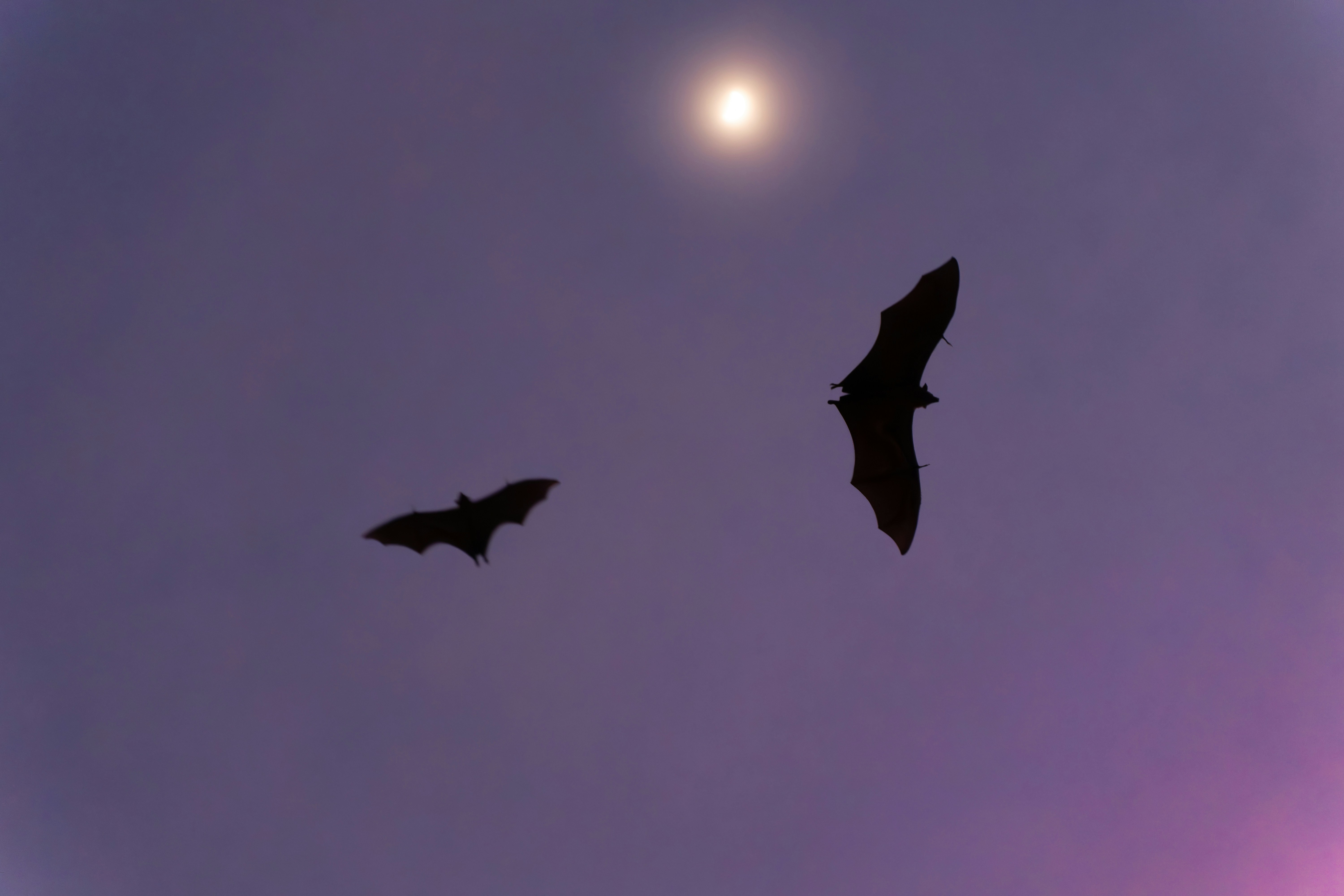
Bats are mammals in the taxonomic order Chiroptera (meaning hand-wing), which, at 1,507 species, is the second-most species-rich order of mammals behind Rodentia.1 That’s right — bats aren’t rodents. In fact, in the tree of life, bats are more closely related to dogs, deer, and horses than they are to rats. Like with many groups of animals and plants, bats are most diverse in the tropics, but we are lucky to have eight species of bats in Minnesota, from the Tri-colored Bat Perimyotis subflavus, which weighs about as much as a nickel, to the Hoary Bat Lasiurus cinereus, which displays striking “frosted tips” coloration to blend in with tree bark.

Bats are a Boon for All of us
Our eight species of bats are all insect-eaters that are predominantly active at dusk and through the night, particularly in summer, using echolocation to detect insect prey and navigate their environments. Bats seek out areas with dense insect activity to meet their high energy requirements. Studies on insectivorous bats, including species found in Minnesota, show that a single bat can eat at least 25 percent — and sometimes more than 100 percent — of their body weight in insects each night!2-4 In addition to keeping insect populations in check, these bats and their hearty appetites help mitigate damage to crops caused by insects. For example, it is estimated that bats help avoid global costs of over $1 billion in crop damage and pesticide use mitigation for corn harvests alone.5,6 In other words, bats are a friend to farmers! Bats, including species of nectar-feeding and fruit-eating bats found in other parts of the world, provide other services for healthy ecosystems, as well. These services include parasite consumption,7 plant pollination, and seed dispersal,8 and even distributing critical nitrogen and phosphate into cave environments from their guano.9
Everyone is Fighting A Bat-tle
Bats also have an interesting and important characteristic that sets them apart from other animals: They carry an unusually high amount of pathogens. Although the reasons why are a topic of continuing research, factors that contribute to their ability to pick up pathogens include their communal roosting behavior and their status as relatively long-lived animals.10 However, just because they pick up pathogens doesn’t mean they are affected by them the same way. Bats are capable of carrying certain kinds of viruses without displaying apparent symptoms.11,12 As with the causes of high pathogen loads in bats, the drivers of bat viral immune response are complex and still not completely understood, but it is suspected that bats have a number of adaptations that make them particularly tough against a class of viruses called RNA viruses, which includes the viruses that cause SARS, COVID-19, and rabies, among many others.13 For example, in humans, rabies is nearly 100 percent fatal, but at least some species of bats seem much more likely to survive even repeated rabies infections.14
Bats are incredibly important organisms for understanding how animals, including humans, respond to infectious agents. They are also important to study because many North American bats are currently imperiled by threats such as predation by cats, wind turbine strikes, and the pathogenic fungus that causes white-nose syndrome. White-nose syndrome was introduced to North American bats in 2006, infecting bats while they hibernate and sometimes wiping out entire colonies in a matter of years. The conservation threats are so severe that estimates suggest more than half of North American bat species face high risk of extinction in the next 15 years.15 As a museum biologist, every deceased bat specimen I receive and prepare for our biology research collection is precious for these reasons. Preserving bat specimens today is the best way to enable future generations of scientists to make discoveries that will help safeguard these important animals!

Bat an Eye
What does this mean for the way humans interact with bats? The vast majority of bats you will see are healthy. However, humans are more likely to encounter bats that are sick, because these are the ones that are unable to fly and might be in conspicuous places, such as on the ground. So what does this mean if you encounter a sick or deceased bat?
First: don’t panic. Seeing a sick bat won’t get you sick and bats don’t pose a threat if left alone. In the case of rabid bats, these animals typically experience what is known as “dumb” rabies, where the bat will be lethargic and unaware of their surroundings, rather than aggressive, as in some other animals. Rabies is transmitted through infected blood, saliva, or nervous tissue, and requires a cut or puncture to infect a person.
Second: call a local bat or wildlife rehabilitation center if you see a bat that appears lethargic, stressed, or unable to fly. You can find one near you and they can provide guidance and/or assistance on relocating the bat.
Third: if you absolutely must handle a bat, understand that handling bats, dead or alive, carries inherent risks, and never handle a bat without thick, puncture-resistant gloves. If you have been injured or suspect you have been injured by a bat, seek immediate medical attention. Rabies is basically 100 percent fatal if left untreated, but is 100 percent treatable if caught early. When in doubt, always seek care.
Finally: if you have confirmed that the bat is dead beyond a shadow of a doubt, the Science Museum of Minnesota and the Bell Museum of Natural History accept bat specimens as a part of our Salvage Wildlife program, which is funded by the Minnesota Environment and Natural Resources Trust Fund. See the link above for information on how to safely collect deceased animal specimens and the type of data needed for us to accept these animals. It is always a good idea to reach out to the museum at [email protected] and let them know you need instructions on dropping off a salvaged specimen. We can turn these tragedies into valuable scientific data. Remember, every bat is precious!
I will admit that one of the reasons why Halloween is one of my favorite times of the year is because, while I’m one of those weirdos who thinks about bats almost incessantly, this holiday brings these amazing mammals a little bit more visibility to people who think about bats a more “normal” amount. As you are gearing up for the season’s festivities, please consider some of these examples of why these creepy chiropterans are fantastic creatures worth protecting and cherishing.
References
- Mammal Diversity Database. (2026). Mammal Diversity Database (Version 2.5) [Data set]. Zenodo. https://doi.org/10.5281/zenodo.17033774
- Coutts, R.A., M.B. Fenton and E. Glen. 1973. Food intake by captive Myotis lucifugus and Eptesicus fuscus (Chiroptera: Vespertilionidae). J. Mammal. 54: 985–990.
- O’Farrell, M.J., E.H. Studier & W.G. Ewing. 1971. Energy utilization and water requirements of captive Myotis thysanodes and Myotis lucifugus (Chiroptera). Comp. Biochem. Physiol. 39:549–552.
- Brisbin, I.L. 1966. Energy-utilization in a captive hoary bat. J. Mammal. 47: 719–720.
- Maine, J. J. & Boyles, J. G. (2015). Bats initiate vital agroecological interactions in corn. Proceedings of the National Academy of Sciences of the United States of America 112, 12438–12443.
- Tuneu-Corral, C., Puig-Montserrat, X., Riba-Bertolín, D., Russo, D., Rebelo, H., Cabeza, M. and López-Baucells, A. (2023), Pest suppression by bats and management strategies to favour it: a global review. Biol Rev, 98: 1564-1582. https://doi.org/10.1111/brv.12967
- Cleveland, C.J., M. Betke, P. Federico, et al. 2006. Economic value of the pest control service provided by Brazilian free-tailed bats in south-central Texas. Front. Ecol. Environ. 4: 238–243
- Kunz, T.H., Braun de Torrez, E., Bauer, D., Lobova, T. and Fleming, T.H. 2011. Ecosystem services provided by bats. Ann. N.Y. Acad. Sci. 1223:1-38.
- Gnaspini, P. & E. Trajano. 2000. Guano communities in tropical caves. In Ecosystems of the World, 30: Subterranean Ecosystems. H. Wilkins, D.C. Culver & W.F. Humphreys Eds.: 251–268. Elsevier. Amsterdam, Netherlands.
- Xu, Y., Laine, V.N., Meramo, K., Santangeli, A., Poosakkannu, A., Suominen, K.M., Gaultier, S., Keller, V., Brotons, L., Pulliainen, A.T. and Lilley, T.M., 2024. Slow-lived birds and bats carry higher pathogen loads. One Earth, 7(6), pp.1121-1132.
- Pavlovich SS, Lovett SP, Koroleva G, Guito JC, Arnold CE, Nagle ER, et al. 2018. The Egyptian rousette genome reveals unexpected features of bat antiviral immunity. Cell. 173:1098–10. doi: 10.1016/j.cell.2018.03.070
- Ahn, M., Anderson, D.E., Zhang, Q., Tan, C.W., Lim, B.L., Luko, K., et al. 2019. Dampened NLRP3-mediated inflammation in bats and implications for a special viral reservoir host. Nat Microbiol. 4:789–799. doi: 10.1038/s41564-019-0371-3
- Banerjee, A., Baker, M.L., Kulcsar, K., Misra, V., Plowright, R. and Mossman, K., 2020. Novel insights into immune systems of bats. Frontiers in immunology, 11, p.26.
- Turmelle, A.S., Jackson, F.R., Green, D., McCracken, G.F. and Rupprecht, C.E., 2010. Host immunity to repeated rabies virus infection in big brown bats. Journal of General Virology, 91(9), pp.2360-2366.
- Adams, A.M., Trujillo, L.A., Campbell, C.J., Akre, K.L., Arroyo‐Cabrales, J., Burns, L., Coleman, J.T., Dixon, R.D., Francis, C.M., Gamba‐Rios, M. and Kuczynska, V., 2024. The state of the bats in North America. Annals of the New York Academy of Sciences, 1541(1), pp.115-128.
.jpg)