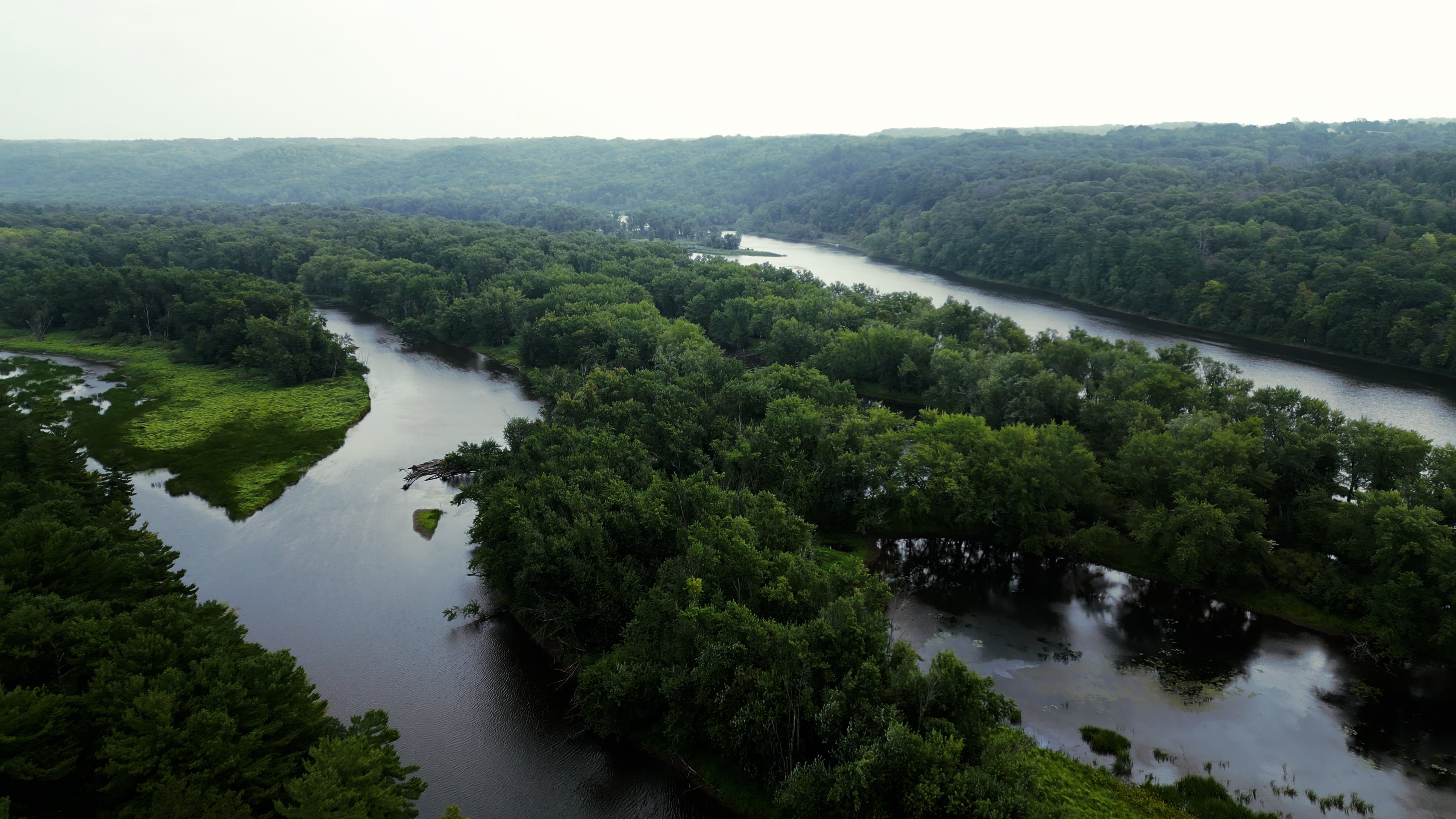
Partnership with the Minnesota Land Trust and Washington County completes permanent protection of the St. Croix Watershed Research Station — more than 300 acres in total
St. Paul, MN and Marine on St. Croix, MN — The Science Museum of Minnesota today announced the finalization of permanent protection of 130 acres of forest and riverfront land at its St. Croix Watershed Research Station (SCWRS), through two new conservation easements.
The easements cover two parcels:
- Tanglewood Nature Preserve — 103 acres of woodland and oak savanna. This easement closed on June 30, 2026 in partnership with the Minnesota Land Trust.
- Pine Needles — 27 acres of old-growth forest along the St. Croix River, a National Scenic Riverway. The property is home to towering white pines, maples, basswoods and freshwater springs. It abuts National Park Service land and looks out over portions of William O’Brien State Park.
Together, the two easements permanently secure the last remaining unprotected acreage at SCWRS, bringing the Research Station’s conserved land to more than 300 acres in total, completing a long-standing Science Museum of Minnesota goal.
Pine Needles has served for 24 years as the home of the Museum’s Artist at Pine Needles Residency program, which has hosted more than 80 artists and welcomed countless St. Croix Valley community members through public outreach events. The new easement ensures the land — and the program it inspires — will endure for future generations.
“Protecting the St. Croix Watershed Research Station in its entirety is one of the most significant conservation achievements in our history,” said Alison Rempel Brown, President and CEO, Science Museum of Minnesota. “This land has supported scientific research and inspired generations of artists, and now it will continue to do that work forever. We’re grateful to the Minnesota Land Trust and Washington County for a partnership that made this possible.”

Under the terms approved by the Museum’s Board of Trustees, proceeds from the Pine Needles and Tanglewood easements are designated specifically for the SCWRS endowment and for capital improvements at the Research Station, providing permanent operational support to sustain the conservation quality of the land for generations to come. The approach mirrors how the Museum has structured its previous conservation easement on SCWRS land with the Minnesota Land Trust and Washington County, a 126-acre easement over the main SCWRS property south of Marine on St. Croix in 2022. The completion of this overall project has been a longstanding goal of the Station since it was founded in 1989.
“This marks a huge win for the Science Museum and the people of the St. Croix Valley,” said Dr. Adam Heathcote, Senior Director of the Department of Water and Climate Change, SCWRS. “This ensures both that these natural lands will be protected forever, but also that we will have the financial support necessary to continue to provide ecological stewardship and world-class scientific research at this site, which is unique to Minnesota.”

“Our long-standing partnership with Science Museum of Minnesota is a natural fit that has enabled not only the protection of these lands and their associated forests, freshwater springs, and grasslands, but the nearby St. Croix River,” said Wayne Ostlie, Director of Land Protection, Minnesota Land Trust. “The St. Croix is a crown jewel in Minnesota’s abundant lakes and rivers and one of the original eight American rivers afforded protection under the 1968 Wild and Scenic Rivers Act.”
“Washington County is proud to invest $900,000 in Land and Water Legacy Program funds toward permanently conserving the Pine Needles property,” said Washington County Commissioner Fran Miron, who represents the project area in District 1. “Since 2006, the Land and Water Legacy Program has invested $19 million in voter-approved funding and leveraged $34 million in partnership funds to protect 1,900 acres of important habitat and natural resources in the county.”
The protection of this property wouldn’t have been possible without Minnesota’s voter-approved Clean Water, Land, and Legacy Amendment and funding from its Outdoor Heritage Fund (OHF) as recommended by the Lessard-Sams Outdoor Heritage Council (LSOHC), as well as the Washington County Land and Water Legacy Program. Washington County voters will have the opportunity to reauthorize this vital program in November so that more conservation projects like this one can be completed in the coming years.
Images and interviews available upon request.
About the Science Museum of Minnesota
The Science Museum of Minnesota is one of the state’s most beloved museums, with a reach that extends well beyond its riverfront location in downtown Saint Paul. Along with serving hundreds of thousands of people each year through its unique combination of cutting-edge technology, hands-on STEM exploration, and world-class collection of fossils and artifacts, the museum reaches schools in all 87 Minnesota counties; provides critical STEM workforce development and leadership training for youth; and conducts research on water quality, climate change, paleontology, and archaeology in locations around the world. Equity work is in the Science Museum’s DNA, demonstrated through its commitment to being a resource to the entire community – at a time when science and scientific learning and equitable access to STEM and STEM careers is more critical than ever. For more information, visit smm.org.
About the Minnesota Land Trust
Since 1991, the Minnesota Land Trust (MLT) has worked alongside landowners and partners to protect and restore nearly 100,000 acres of forests, wetlands, prairies, and shorelines — places that don’t just make this state beautiful, but make life here possible. These lands filter the water we drink, shelter the wildlife that lives alongside us, and connect communities.
Today, MLT is one of the largest land trusts in the country by project volume and service area, carrying out permanent protection and landscape-level habitat restoration projects across the entire state. It also partners with communities, camps, and other organizations to expand outdoor recreation and educational opportunities to continue to support a strong statewide conservation ethic. For more information, visit mnland.org.
About Washington County
Washington County is home to more than 280,000 people, covers 423 square miles, and features diverse landscapes, from farmland to suburban neighborhoods, and natural resources. An elected five-person board of commissioners manages county operations, approves the county budget, and directs county services and programs, including its land conservation efforts. In November 2006, Washington County voters approved a $20 million land and water protection referendum, creating the county’s Land and Water Legacy Program. The LWLP works with willing landowners to purchase land for the county’s regional parks and place conservation easements on land to permanently protect natural resources. For more information, visit WashingtonCountyMN.gov/LWLP.