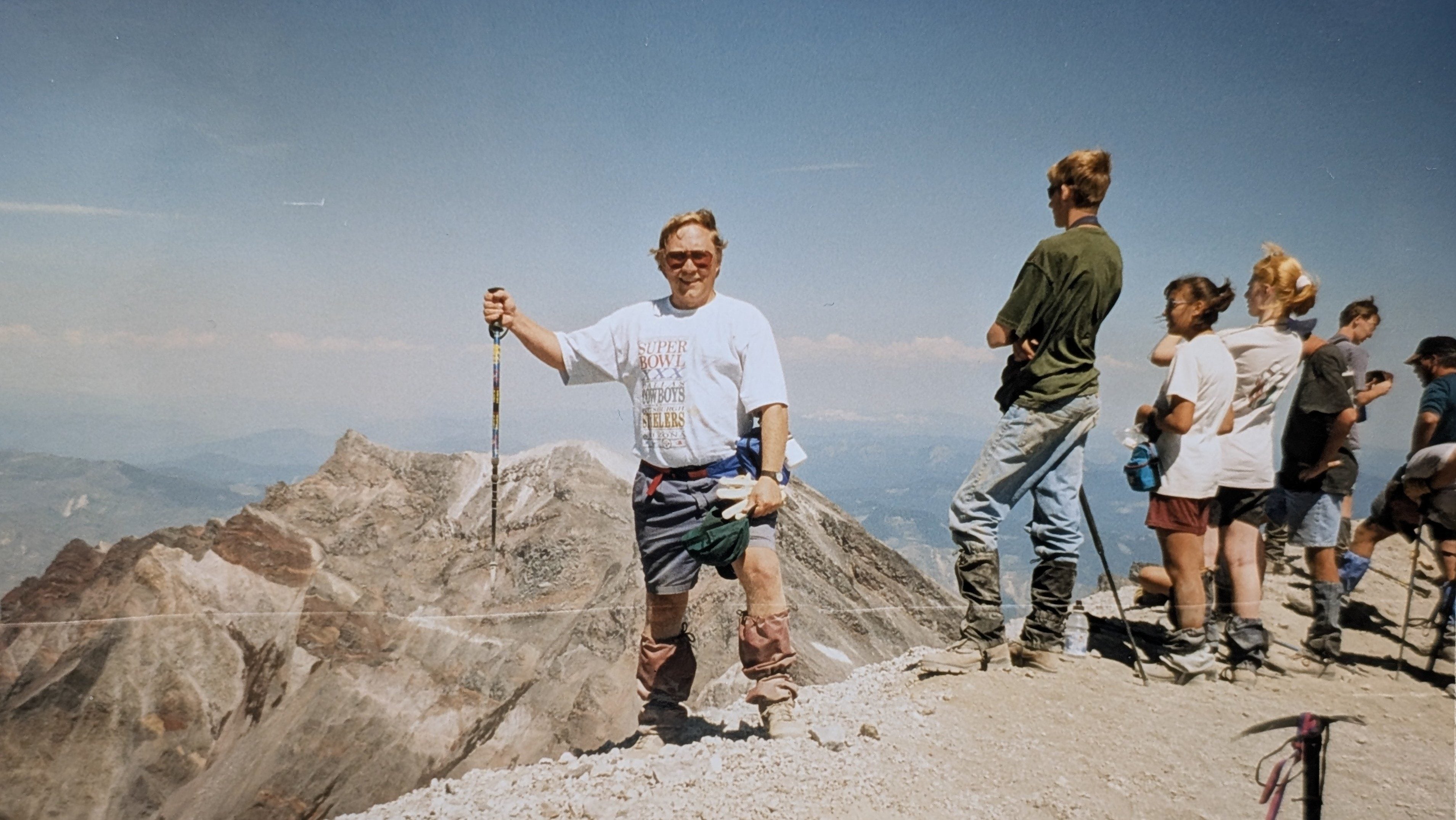
For more than 40 years, William “Rick” Stevens showed up for his students — not just in the classroom, but in the field, under the stars, and wherever curiosity led. As a middle school earth science teacher in North Dakota, Rick made it his mission to ensure every student, especially those with fewer resources, felt capable of discovery.
That same spirit carried into his family life. The Science Museum of Minnesota became a cherished gathering place across generations, a space where Rick’s love of science and his love of family came together naturally.
When Rick passed away unexpectedly nearly two years ago, his family honored his memory with gifts to the Science Museum — ensuring that his core belief, that every child deserves access to the joy of discovery, would live on. Recently, the Microscope corresponded with his Wife Vicki and Daughter Jessica Bossman to hear more about the teacher, the father, and the legacy he left behind.

Tell us a little about who Rick Stevens was — as a teacher, as a dad, and as someone who loved science.
Rick’s interest in science started at a very young age. He was always exploring and searching for arrowheads, unique rocks, and fossils. His Uncle Tom sparked his love for the outdoors and bird watching, which became a lifelong passion. During his school years, he developed a strong desire to educate and inspire youth, ultimately leading him to a career teaching earth science. Through hands-on lessons such as building and launching rockets, mineral and rock identification competitions, and the use of Starlab — an inflatable planetarium, he brought science learning to life. It was important to him to continue learning and incorporate new discoveries into the curriculum. He also passed his love of science on to me. His daughter Jessica experienced firsthand the wonders of nature and exploration. Rick had a special gift for connecting with people across generations, whether through coaching, teaching, or volunteering. His passion for science and education leaves behind a lasting legacy that will continue to inspire curiosity and discovery for generations to come.
Rick spent more than 40 years teaching earth science, and was known for taking students into the field rather than keeping them in the classroom. What drove that approach, and do you have a favorite story of him in action?
Rick and his colleague, Steve Fogarty, were inspired by their own college professors, who took the time to bring students into the field to experience geology firsthand. Through those experiences, it became clear that there was far more to learn beyond the classroom. Geology is an outdoor science — one that is difficult to fully replicate or experience within the confines of a classroom due to its scale and complexity. To truly understand it, you need to experience the Earth with your eyes, ears, and hands. Only then can lasting knowledge and a deep appreciation of the subject take hold. From that realization, Geology Search Enterprises was born — offering students the opportunity to explore, discover, and learn through immersive, hands-on summer geology field trips.
On a joint field trip with other middle school teachers and 23 students, while searching for minerals in a road cut Rick said, “Speaking of fossils, look at that!” Right there on the surface was a prehistoric crocodile skull sticking out of the ground. With their bare hands, they carefully removed the fossil to bring home for identification. A fossil expert in town at the time determined it was a 40 million year old crocodile skull. They were then tasked to clean, assemble, and preserve this historical find.

The Science Museum of Minnesota was clearly a special place for your family. What do your earliest memories of visiting look like, and what made it feel like more than just a field trip?
Visiting the science museum was a special family outing that gave each of us the chance to explore our individual interests together. We were especially impressed by how immersive the exhibits felt, making it seem as though we were truly part of each scene. Everything was so lifelike and realistic that you could easily lose yourself in the experience. The special exhibits, such as the Dead Sea Scrolls, were particularly memorable, offering a rare opportunity to see artifacts we might never otherwise have the chance to encounter.
When Rick passed, the family chose to direct memorial gifts to the museum. How did that decision come about? Was it something he expressed, or something the family felt reflected who he was?

In honor of Rick’s memory, our family chose to support the Science Museum of Minnesota by funding opportunities for students to attend science camps — so they, too, can experience the wonder and inspiration of science that he dedicated his life to.
Rick was especially committed to students who lacked resources — making sure they felt capable of discovery. Why was that so important to him, and do you see that value living on through this scholarship?
Rick believed every student deserved the opportunity to discover all that scientific exploration can reveal. He often said that if he could inspire even one student towards exploring science, that would be enough. But the support of scholarships has paved the way for many more students to be encouraged and shaped by the excitement of scientific discovery.
Your family has brought the next generation of science enthusiasts to the Science Museum. What does it feel like to be in those same spaces with a new generation?
When the grandkids first visited the science museum at a young age, their expressions of wonder and awe as they took everything in filled Rick with a deep sense of pride. He cherished being able to share his love and excitement for science with them. Those lasting memories not only connect them to their grandfather, but also inspire their growing curiosity and desire to explore all facets of science.
The northern lights moment mentioned in your story is a beautiful image. Are there other moments — big or small — where you’ve felt his presence or felt like his love of science is still rippling forward?
An additional memory that comes to mind is the night of the planetary alignment. For the first time, the grandkids were able to see the moon and planets up close through Rick’s personal telescope. He would have loved to share that experience with them, yet his presence was deeply felt as we turned the telescope toward the universe’s masterpieces. Rick often comes to mind in the little moments — through the many species of birds that visit our yard, unexpectedly coming across a rock cairn (affectionately known as a Rock Johnny), or witnessing the next stage of space exploration. Science has a unique way of inspiring wonder in all of us, reminding us just how vast the universe is and how special it is to share even a small piece of it with the people we love.


Donate to Rick’s scholarship fund; make a note upon checkout about your preferences for the donation.