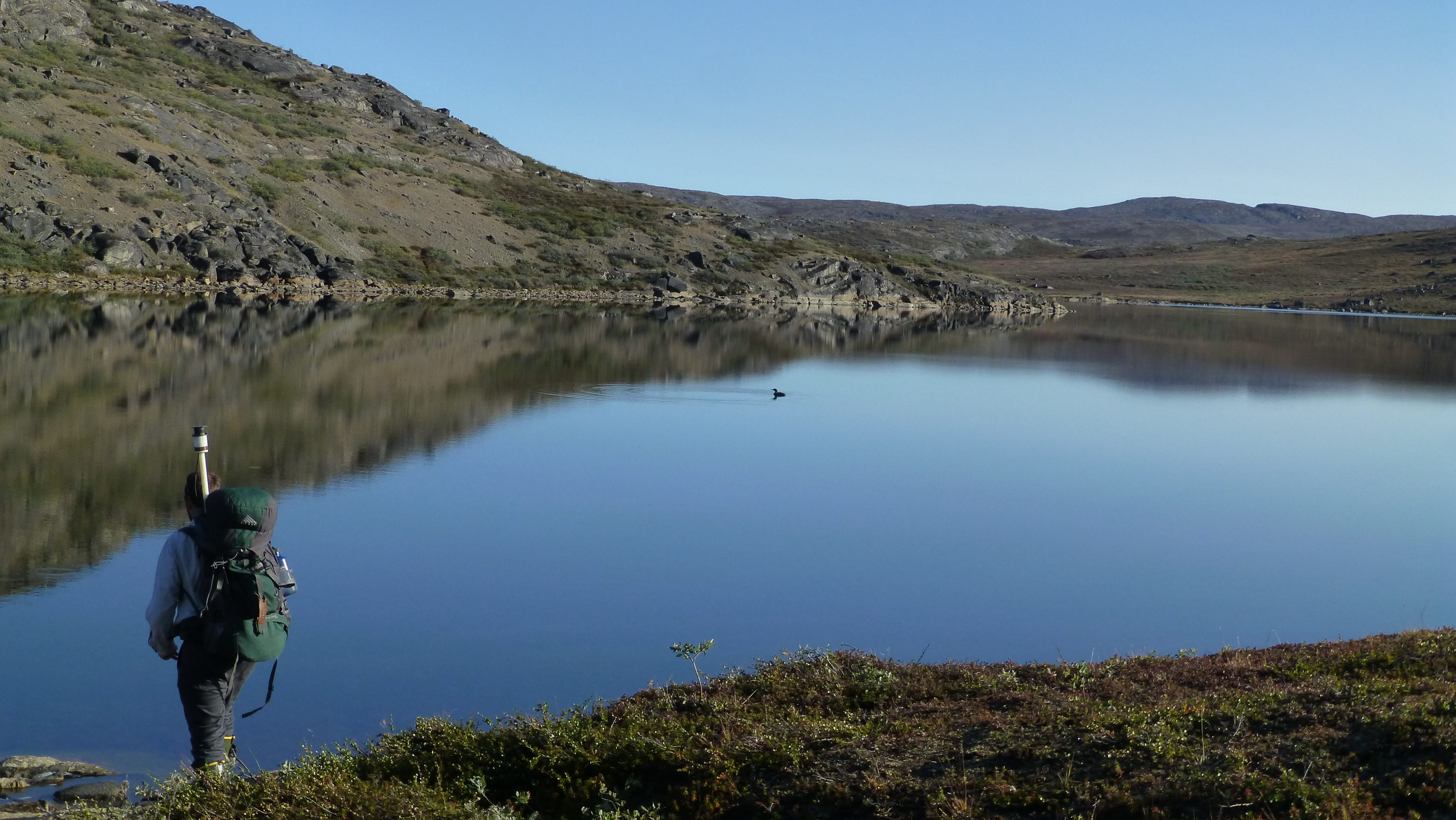
Recently, the Microscope chatted with Dr. Adam Heathcote, Director of the St. Croix Watershed Research Station, about the Dynamics of Extreme Climate Disturbance in Arctic Lakes project.

In 2021, if you visited the lakes neighboring the small town of Kangerlussuaq, Greenland you would be greeted by crystalline blue waters, so clear they’d appear distilled. Step into the same spot a year later, and you’d puzzle over how the once transparent lakes were now brown.
What changed? How did this transformation occur in a single season? The answer is in the air.
In fall 2022, an extreme climate event poured down on the normally arid areas of southwest Greenland. With exceptionally low precipitation rates — less than 200 millimeters annually — and continuous permafrost, the region near Kangerlussaq can resemble a polar desert. During this time period, intense amounts of moisture in the atmosphere, called atmospheric rivers, moved upwards from the equator and across the Arctic to dump enormous amounts of rain across the typically dry terrain.
This short-lived climatic phenomena triggered lasting impacts, causing those previously crystal-clear lakes to transition to a murky, dark brown hue over the course of the year. As the permafrost began to thaw, organic carbon and iron trapped in the frozen layers began to seep into the area’s lakes through growing fractures. A process that would normally naturally occur over the course of thousands of years transformed the terrain more rapidly than had ever been observed before.

Local Angle
This is where the museum’s own Dr. Adam Heathcote steps in. Over the course of the next 10 years and in collaboration with the University of Maine Climate Change Institute, Dr. Heathcote and fellow St. Croix Watershed Research Station scientist Dr. Lienne Senthna will monitor 10 impacted lakes in the hopes of answering a few key questions: Was this a standalone event, and will these lakes recover?
“This is unprecedented,” Dr. Heathcote said. “This has never been seen anywhere else and we truly don’t know what is going to happen over the next 10 years. From a scientific standpoint this is exciting, but the future uncertainty for these lakes and those elsewhere in the Arctic is also concerning.”
Over the next decade, Dr. Heathcote and his team will monitor the lakes’ potential recovery, tracking any changes in color and chemical makeup. They’ll pay close attention to the cycling of carbon in an effort to identify positive feedback loops: As the permafrost thaws and releases organic carbon that has been trapped for thousands of years, if this carbon is transformed into CO2 it will enhance warming, causing more thawing and more carbon release, happening again and again and faster and faster.
“This is why scientists are constantly updating future climate predictions, because as we actually observe these changes happening at the ecosystem level, we keep finding unexpected feedback loops which humans have not previously observed ,” Dr. Heathcote said, a phenomenon that’s not unique to Greenland. “These rapid responses to warming in Arctic lakes is a good indication of how ecosystems may change elsewhere, including here in Minnesota.”

While the Arctic is the fastest warming place on the planet — warming more than twice as fast as the rest of the planet — it can serve as an example of what to expect in other northern biomes like the boreal forest. The coniferous taiga that blankets large swaths of Canada and northern Minnesota is similarly threatened by climate shifts and is second only to the Arctic in terms of the measured rate of warming. Minnesota has already recorded the loss of coldwater fish species in some lakes, leading to food web disruption. Learning about how lakes in Greenland respond to warming can help inform natural resource managers back home in Minnesota.
Teacher Feature
Collecting data to better understand how lakes will respond to climate change isn’t the only contribution of this project to the future of Minnesota. Through funding from the National Science Foundation, Dr. Heathcote and his fellow scientists won’t be the only inquisitive minds visiting the top of the world. This year, Hastings Public Schools science teacher Jill Jensen will join the researchers on their two-week excursion, and South St. Paul educator Scott Youdas will embark on the next.
The goal? A true field experience centered around data collection and curriculum development, giving the teachers opportunities to see science up close and bring it back to their schools. Through educational videos and photos, Jill hopes to make the abstract more apparent — transforming an Arctic research expedition from an exciting anecdote in a textbook to real-life experience to which her students can aspire.
“We’re giving teachers hands-on experience and letting them observe firsthand these things that are happening in the Arctic, so when they relay that to the students, not only do they have a deeper understanding of it, they have more credibility because they’ve actually been there,” Dr. Heathcote said.