Recently, the Microscope had a chat with Lienne Sethna, Associate Scientist, about the St. Croix Watershed Research Station’s work on the Wilderness Lakes project.
Algae are a vital component of an ecosystem, producing most of Earth’s breathable oxygen, removing carbon dioxide, and forming the base of the aquatic food web. Yet, like many things, balance is key. Nutrient pollution, typically from stormwater and wastewater runoff, can cause harmful algal blooms (HABs), often by cyanobacteria, which can be dangerous to wildlife and people, as well as disruptive to the entire food chain.
HABs are a common problem in lakes near farms and cities. But the Boundary Waters? These are some of the most pristine, remote, and protected lakes in the country. Their watersheds are largely intact. These waters are free of neighboring roads, motors, and agricultural fields. Yet, harmful algae has bloomed there — and by some measures, rivaled conditions found in the most polluted aquatic systems in the world.

This discovery launched the Wilderness Lakes Project, a research initiative based at the St. Croix Watershed Research Station and funded through the Minnesota Environment and Natural Resources Trust Fund. The questions it raised were immediate: How is this happening? Where are the increased levels of HABs coming from? Early hypotheses ranged from ash falling on lake surfaces to agricultural dust blowing in — or simply the fact that lakes at northern latitudes are warming faster than nearly anywhere else on Earth.
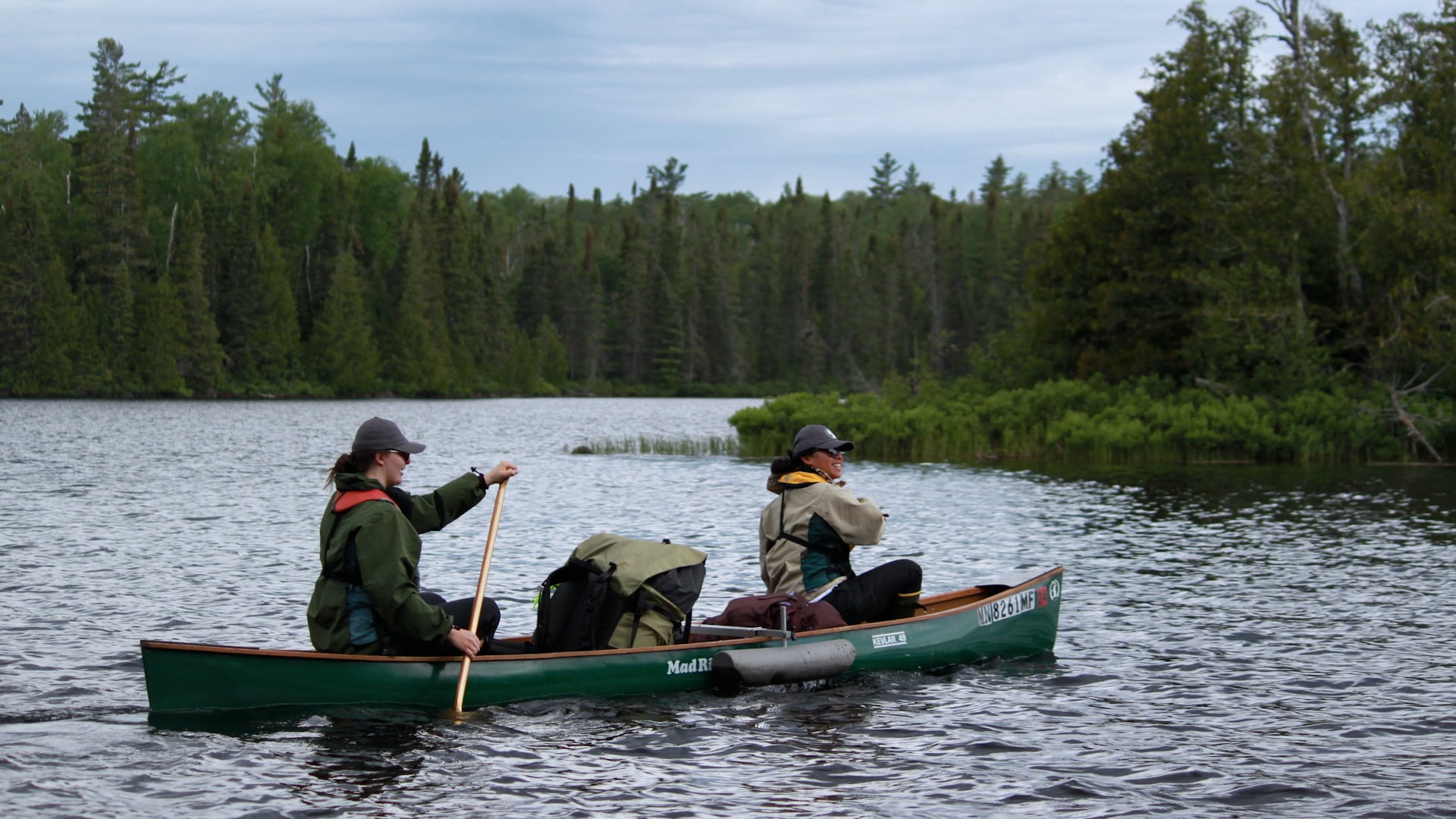
Beginning in 2022, the team embarked on a year of intensive monitoring across lakes within the Boundary Waters and Superior National Forest. Getting there was no small feat. Every piece of equipment had to be packed in on foot and by canoe, portaging through mosquito clouds, and in winter, dragging sleds of sampling gear across frozen lakes. The team visited study sites once a month for five months, yielding a dataset unlike anything previously gathered in this region.

The team of scientists from the St. Croix Watershed Research station We deployed high-resolution buoys that continuously measured lake temperature and dissolved oxygen throughout the entire water column every ten minutes. Alongside these, atmospheric deposition samplers captured not just rain and snow, but dust, connecting them to a National Atmospheric Deposition Program originally established in the 1980s to study acid rain. The team aimed to solve the question of whether agricultural dust blowing in from the Dakotas was carrying enough nutrients to trigger blooms in these otherwise isolated lakes.
To look further back in time, our scientists extracted sediment cores from the lake bottoms. By analyzing these, we could ask: Are blooms worse now than 50 years ago? 150 years ago? Is this a problem that has always existed and therefore, predictable?
After a full year of monitoring data came in, the picture became clear. It pointed not to atmospheric dust or distant agricultural runoff, but to a process happening within the lakes themselves.
Most Minnesota lake swimmers are familiar with the phenomenon of reaching a cold layer of water as you dive deeper. That temperature separation — called stratification — is a normal part of a lake’s seasonal cycle. Warmer, less dense water sits on top while cold, nutrient-rich water stays near the bottom. Due to predictable changes in season, water temperatures equalize and the lake experiences “turnover”, completely mixing the bottom and top layers and cycling nutrients up from the sediments.
What the buoy data revealed was that in the lakes where blooms were forming, stratification occurred intermittently and in unpredictable patterns. As the bottom layer became isolated from the surface, oxygen levels dropped. Without oxygen, the lake sediments began releasing phosphorus — a key nutrient that drives algae growth — into the water column in a process called internal loading. When the lake mixed, that phosphorus-rich water surged up into the warm, sunlit surface layer. With warm temperatures still lingering and plenty of light, conditions were ideal for cyanobacteria to take over.
The pattern was consistent across every lake in the study that experienced a bloom. Crucially, all of those lakes shared a specific characteristic: They were relatively shallow. Lakes of this depth occupy a “Goldilocks” zone — deep enough to stratify, but shallow enough that when mixing occurs, the phosphorus pulse reaches the surface while temperatures are still warm enough to fuel a bloom. The shared characteristic, the data seemed to suggest, was temperature change. As the atmosphere warms, lakes in this specific depth range are increasingly likely to see this spread of cyanobacteria – and the harmful repercussions of the imbalance to the food web.

The sediment cores also made one thing clear: Tthese lakes have not always looked like this. The intensification of blooms is a recent phenomenon, and the evidence ties it directly to a warming climate.
These results answered our initial research questions, but also left us with more. How widespread is this issue? Could more data help us be predictive about the future health of these lakes? Would collecting data more frequently – weekly, rather than monthly, and over the course of years, rather than one – allow us to better characterize the effects of mixing on water quality? Are conditions worsening, and at what rates? Fortunately, thanks to additional funding from the Trust Fund, we are continuing this project with a second phase that will expand the scope in timing, geography, and by inviting partnerships with other organizations.
We hope to understand the drivers of cyanoHABs in Minnesota lakes and can help direct management efforts to prevent and mitigate future blooms.