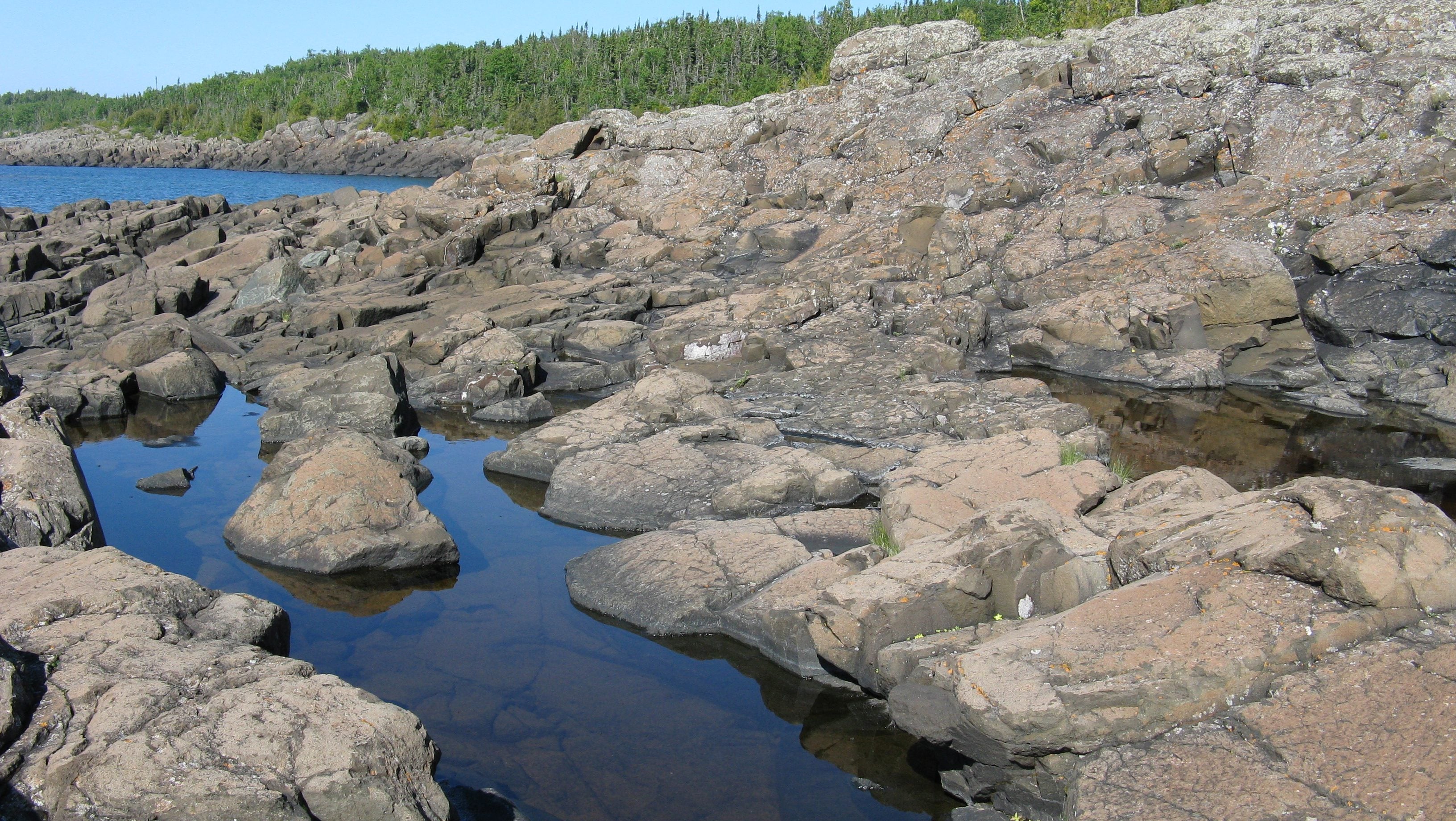
Recently, the Microscope had a chat with Assistant Scientist Hailey Sauer about the St. Croix Watershed Research Station’s work on the Superior Shores Rock Pools project.
Have you ever noticed the small, rocky crevices carved into the shoreline of Lake Superior? These rock pools are more than just a scenic feature they are dynamic microhabitats that support a surprisingly diverse web of life. Tucked into the ancient bedrock of Minnesota’s North Shore — some carved by waves, others by glaciers thousands of years ago — these freshwater pools function much like the tide pools of the ocean coast: critical refuges where animals feed, shelter, and reproduce. Leopard frogs deposit eggs in them. Dragonflies complete their life cycles in them. Yet, despite this ecological significance, they’ve never been comprehensively mapped or studied.

The Superior Shores Project, funded through the Environment and Natural Resources Trust Fund, is setting out to change that. Led by the St. Croix Watershed Research Station, the project will systematically inventory rock pools across five to six high-density areas along Lake Superior’s shoreline. Beginning in late May 2026, the team will collect the first round of aerial imagery, using drone technology to survey dense pool clusters that would be impractical to document on foot. The goal isn’t just to count pools — it’s to understand what’s living in them, how water enters and exits (whether from lake waves or precipitation alone), and how these ecosystems shift across seasons and years.
A key goal for this project — and for understanding the waters of Minnesota’s North Shore as a whole — is to uncover how much variation exists between pools that sit only meters apart. Some receive regular wave splash from the lake, making them extensions of Superior. Others sit just slightly inland, fed entirely by rain, making them ephemeral — present in a wet summer, dry in a drought. That difference in water can influence what organisms can survive and what nutrients are present. The project will monitor water quality across pools, tracking what is collecting from the lake versus what is falling from the sky, and what that means for the algae, invertebrates, amphibians, and insects that call these micro-worlds home.

The Superior Shores Project also turns its attention to the role of people within these ecosystems. On a hot summer day in Grand Marais, at places like Artist’s Point, visitors wade into these pools without a second thought — splash around, run nets through the water — because the lake itself is far too cold to play in. But what happens when lathered sunscreen washes off in a closed pool system? Does microplastic accumulation look different in heavily trafficked pools versus remote ones that rarely see visitors? The Station’s scientists are curious whether the presence of humans leaves a measurable signal in these pools. The hope is that high-traffic and low-access pools can be compared side by side to find out, and that we can perhaps begin to map out a predictive set of data for the future.

Alongside the scientific work, the project has a community dimension. The team is partnering with Minnesota Children’s Press in Grand Marais — the publisher behind the beloved “rock snot book” — to develop materials that bring this research to young audiences, and is exploring an “Adopt a Rock Pool” citizen science program that would invite local residents and visitors to observe and document pools over time. A story map tracing the seasonal progression of pool life is also in the works, giving the public a window into how these habitats change through the seasons.
The final deliverables will live on Minnesota’s Geospatial Commons as publicly accessible distribution and density maps, a resource that researchers, land managers, and conservation advocates can build on for years. If the team finds something rare — a cluster of pools harboring an uncommon amphibian species or an unusual assemblage of organisms — that data goes directly to the people who need it most. This project is about more than mapping: It’s about making the case that these small, overlooked features of the Lake Superior shoreline deserve the same care and attention we’ve long given to the lake itself.