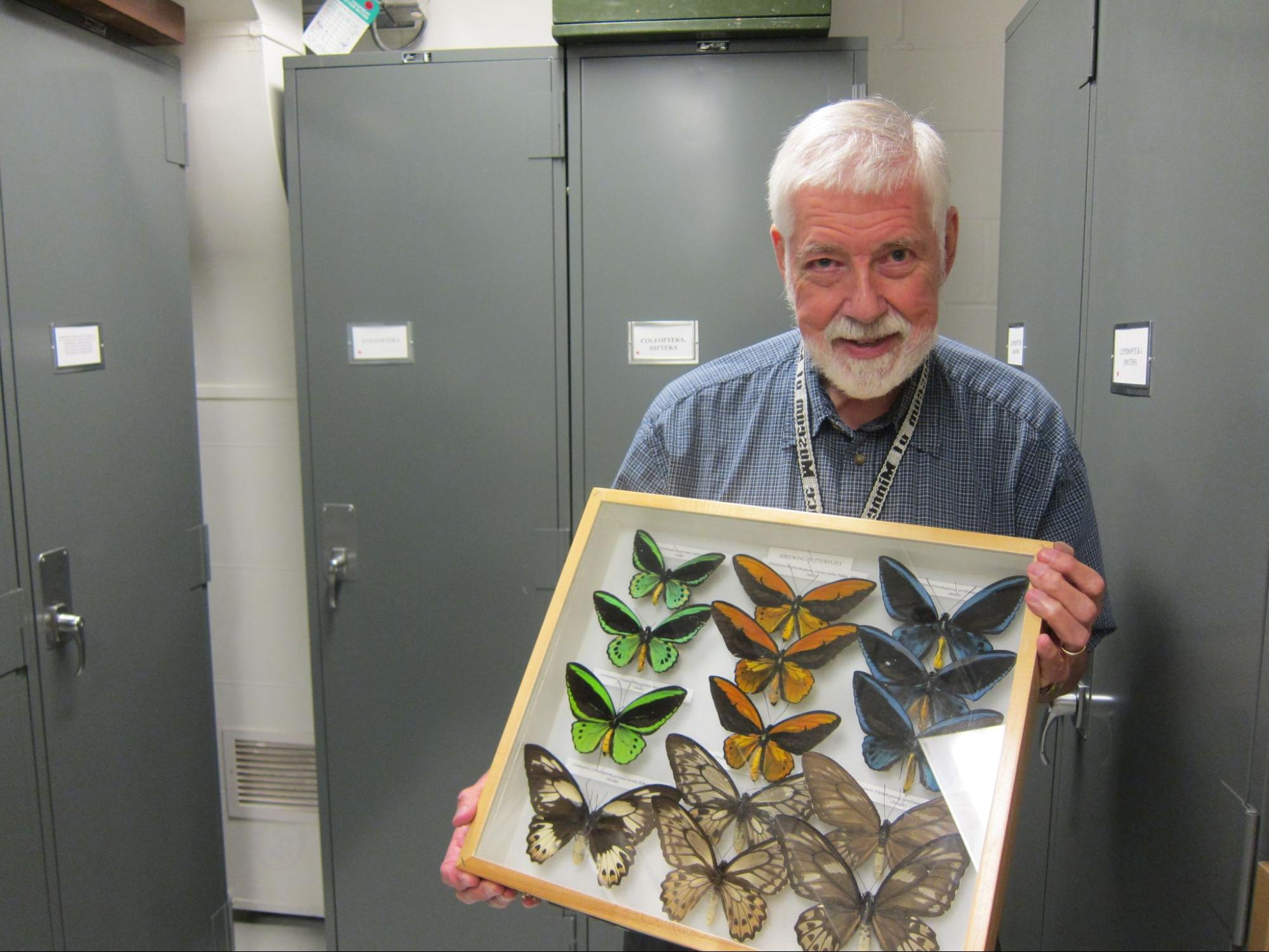
Ron Huber turns off his phone when he’s at the museum.
Upon arrival, he makes just one phone call, always to the same number. On the answering side: his wife of 43 years, Cathy. The pair’s ‘how we met’ story rivals that of any great love story… but likely involves more wings than the average romance novel.

Ron, an entomology enthusiast, was often looking for new recruits for the Association of Minnesota Entomologists group at the University of Minnesota in 1976. Cathy, an artist and avid gardener, took interest in the colorful larvae that were eating parsley in her normally bountiful backyard vegetable patch. The couple can credit their eventual courtship to a mutual appreciation for winged things, and a mutual subscription to the Lepidopterists’ Society — a nonprofit worldwide organization promoting the study and research of butterflies and moths. One day, Ron’s usual scan of the Society’s new member list yielded Cathy’s name as a result.
“So I got out the phone book, looked up the phone number, and called her,” Ron said. And he told her “We have a little local group. If you would be interested, come to the meetings, meet our group, and see what we do with butterflies.”
After marveling at how the pesky larvae blossomed into black swallowtails, Cathy decided to join the group on their weekend road trips to all parts of Minnesota in search of nature’s finest specimens. Even when other members of the group were busy, Cathy and Ron continued their excursions.
“We just kept going, and we just got more and more interested in each other. Eventually we decided to get together for dinners on Wednesday nights, and then it kind of became a relationship,” Ron said.

The ritual that began his courtship — a phone call to Cathy — has continued into Ron’s 60-year volunteering routine. As a biology lab volunteer, Ron spends his Thursdays identifying, labeling, and organizing specimens in the museum’s vast collection, many of which Ron and Cathy collected. Ron’s passion for specimen collection began in high school (1954), after discovering a bright green beetle underneath his family’s outside milk delivery box.
“So I brought it in, and didn’t know anything about it, but I pinned it with a house pin and wrote something like ‘backyard, Minneapolis,’” Ron said. Through the help of a few birding mentors, he would later identify it as a tiger beetle. Understanding Ron’s interest in these insects, one of his mentors sold Ron a box of Cicindelidae specimens. He combed through the box of thirty or so specimens with precision and criticism, consulting literature and experts at the University of Minnesota to determine some of the beetles in the collection were erroneously identified.
“That was a fascinating experience,” Ron said. “That really got me going on tiger beetles. That launched me.” In 1969, he published his first edition of a specialty tiger beetle journal — Cicindela — and has acted as managing editor of the quarterly journal ever since. There are now subscribers on four continents.
Ron’s collected specimens extend far beyond the iridescent green and black coleopterans that inspired his work, writings, and relationship. The most prized insect in his possession is a South American beetle that came to him from a professor in Arizona. It came to him as a result of his expert identification abilities. Because of Ron’s knack for the creature he once found under a milk box, this professor asked him to identify around 3,000 specimens of tiger beetles. Ron named seven new species of tiger beetles, one of which previously only had a singular specimen on record.
“‘He had collected five of those. And I thought, ‘Whoa, this is one of the rarest beetles in the world,’” As compensation for his time and efforts, it was agreed that Ron was able to keep 20% of all he identified, which meant he was the proud new owner of one of the rare beetles. “It turns out it was the same genus, but a new species. Since we published that paper, a number of collectors from around the world have visited South America to look for those seven species.”
It’s worth noting this was not the last time Ron’s discovery of a species sparked new or increased collecting efforts for an insect. While on a collecting trip in a remote part of northern Minnesota woods, Ron surprisingly encountered a man emerging from the dense brush with a butterfly net. Upon introduction, the Wisconsin collector told Ron that Ron was the reason he made the trek from Wisconsin — he was in search of the Freija fritillary butterfly which Ron had recorded as the first United States specimen and then published it in the Lepidopterists’ Society newsletter.

“It’s the thrill of discovery, that’s what keeps you going,” Ron said. “Then you want to share it with other people, by publishing records so they can get on the bandwagon.”
Now, those butterflies are finding a new home. Ron and Cathy’s life’s work — more than 10,000 specimens collected over 73 years — has made its way into the museum collections, an incomparable gift that will advance our scientific understanding of the natural world for generations to come.


The museum’s entomology collection began as two cabinets of specimens when Ron first began volunteering. While it’s grown during his time here, Ron’s — and his wife Cathy’s — contributions will increase the program considerably. The museum’s collection is home to primarily butterflies and moths, but on their field trips, Ron and Cathy also collected a wealth of other insect species.
“My thought has always been that this collection has got to go to the Science Museum,” Ron said. “We wanted the collection to go somewhere we knew it was going to be well-taken care of.”

As Ron’s collecting excursions decrease in frequency, he encourages future collectors to get outside and explore.
“The more you learn, the more exciting it’s going to be. Try to share that information with others.” Ron emphasized the importance of collections in providing information of what used to be, and crucial data points for future scientific studies. “Those will eventually be gems and treasures in their own right.”