Recently, the Microscope had a conversation with Dr. Catherine Early, Barbara Brown Chair of Ornithology, about the Biology Department’s work and impact. This post contains excerpts from that chat.

Biology is the study of life in all its forms, from the tiniest microorganisms to the largest mammals, from individual cells to entire ecosystems. By studying biology, we gain insights into the intricate web of relationships that sustain life on Earth and our place within it.
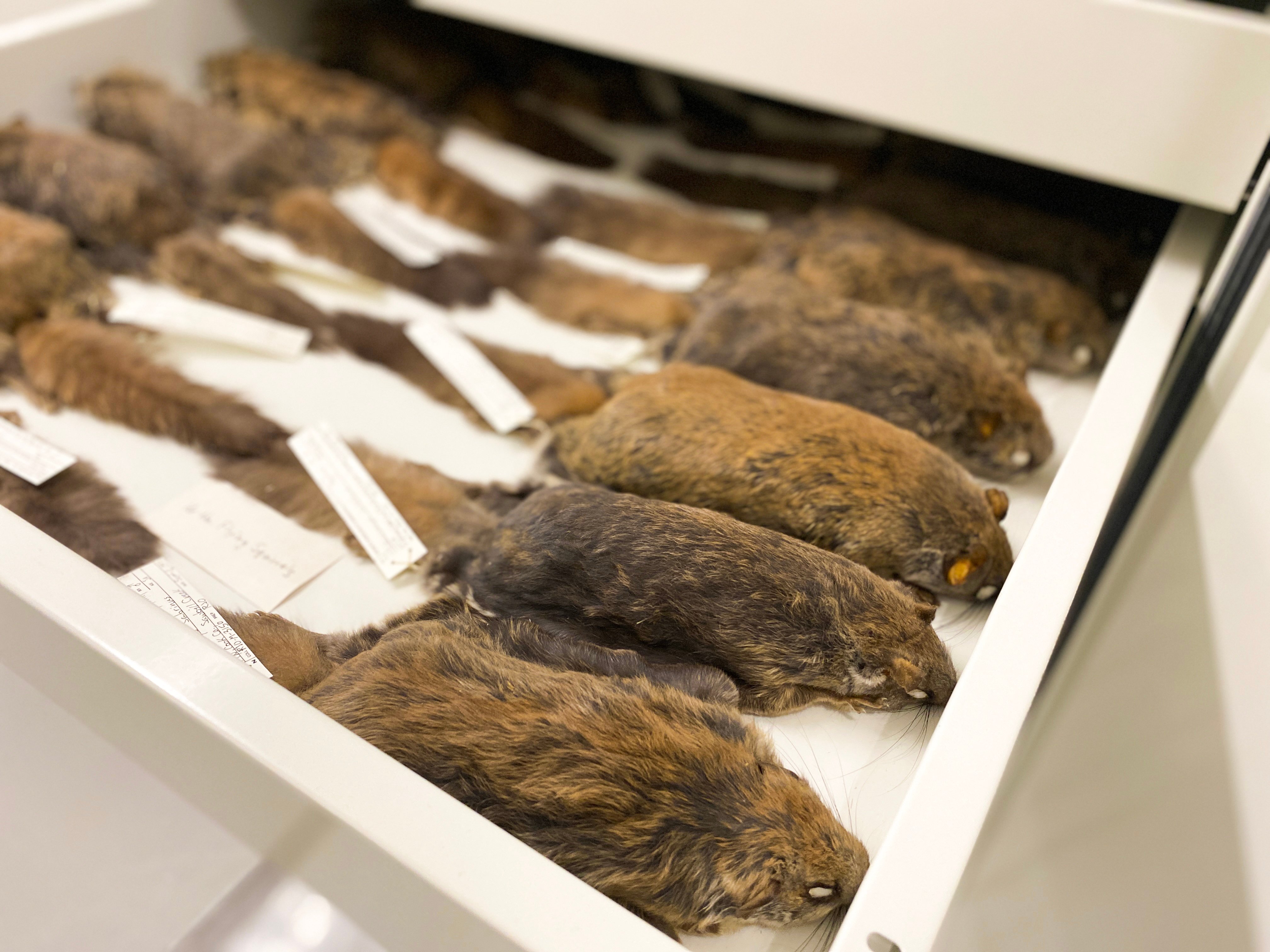
At the Science Museum of Minnesota, we hold an extensive biology collection and employ biologists in our active biology lab. Our collection and research focuses on animals and plants. We think of this work as both looking to the past to make discoveries that can impact us now, but also as an essential tool for future generations of problem-solvers.
Our predecessors collected specimens throughout history and meticulously documented where and when they found them, creating an irreplaceable record we cannot reverse engineer. While one specimen is interesting, the true power emerges when we combine thousands of specimens to build a comprehensive understanding of how species and ecosystems have changed over time.
These collections serve as a scientific time capsule. The power of museum collections becomes clear when we examine their role in solving critical mysteries. In the 1970s, scientists used various museum egg collections to solve the mystery of why birds of prey were nearly extinct, discovering that the fertilizer DDT prevented proper calcium formation in eggshells and almost cost us the bald eagle. In the early 1990s, when a respiratory disease outbreak struck the Navajo nation, scientists consulted museums with small mammal collections to identify the virus and discovered it wasn’t new — just that unusual weather patterns had created a population boom in the mammals carrying it.
One of the reasons the origin and cause of the COVID-19 virus was so hard to pinpoint is because it arose in an area without extensive museum collections of relevant species, without the specialized equipment needed to preserve them. These archives are crucial for future disease research. We hope to be one of those institutions with not only the know-how, but the physical technology, like a state-of-the-art tissue freezer, that can help solve these future mysteries — perhaps with global implications. We’re stewarding specimens that will help solve problems we haven’t even identified yet, using methods that don’t exist today.

But the collection is not just about solving intangible future problems. Beyond future scientific breakthroughs, collections provide immediate mentorship opportunities for students, interns, and visitors of all ages. Collections help visitors become comfortable discussing death, observing anatomy, and engaging with other topics that are essential parts of biological understanding and scientific decision-making.
Research shows that children especially value and learn more effectively from interacting with real specimens rather than replicas. Collections provide the best chance for seeing animals up close in an educational context. Also, exposing people to museum and collections work helps them understand this as a potential career path. We can create customized projects for student workers, interns, and volunteers, helping them build portfolios while contributing to our mission and the science.
Digital access allows people to explore and learn from collections even when they can’t visit in person, exponentially expanding our educational reach and connecting researchers worldwide. One of our most active initiatives currently is digitizing our specimens and their data, and thanks to our partnership with the Bell Museum, you can explore some of our holdings on the Minnesota Biodiversity Atlas. We welcome you to explore our collections through that portal and make discoveries of your own. How many specimens in our collection came from your home county?
In a world facing unprecedented environmental challenges, these collections represent hope — evidence of what was, knowledge of what is, and the tools to shape what could be. Through careful stewardship of these irreplaceable scientific resources, we ensure future generations will have the evidence they need to solve problems we haven’t even identified yet.