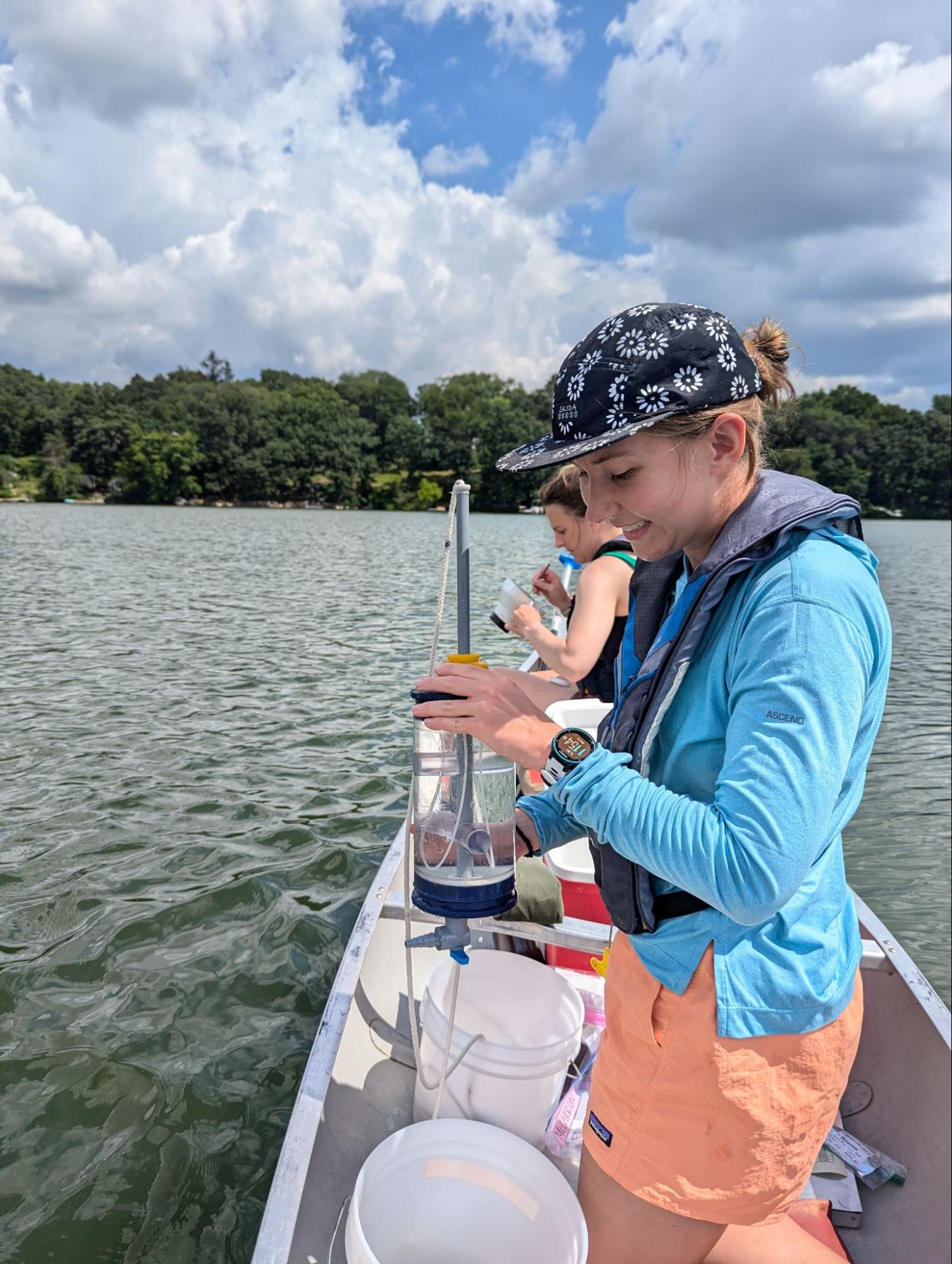
The Science Museum’s water and climate scientists are headquartered at the St. Croix Watershed Research Station but work on projects around the world. Below are some highlights from their past year:
SCWRS Director elected to ASLO Board of Directors
Dr. Adam Heathcote, Director of the Department of Water and Climate Change, was elected to the Board of Directors of the Association for the Sciences of Limnology and Oceanography (ASLO), the largest international society representing freshwater and marine scientists. Dr. Heathcote has been a member of ASLO for more than 15 years and has regularly presented research, convened special sessions, and hosted workshops at their annual meetings. He was previously named a Fellow of the Society in 2023. Dr. Heathcote is excited to serve his community in this expanded role and especially honored to be elected by his peers.
New study completed on the impact of salt on Minnesota lakes
In August, we completed a three-year project to characterize the impacts of salt on Minnesota lakes, a pioneering study funded by the Environment and Natural Resources Trust Fund. Led by Senior Scientist Dr. Mark Edlund and Postdoctoral Fellow Dr. Hailey Sauer, this effort combined water quality monitoring and sediment core reconstructions to better understand how salt pollution impacts our lakes. By studying 15 lakes spread across the Twin Cities area and the city of Alexandria, Station researchers characterized the current and future risk of salt pollution on lakes with a focus on how chloride toxicity could impact zooplankton, a crucial link in the aquatic foodweb, and how changes to water density caused by salt may impact internal loading of phosphorus and the emission of methane from lakes.

SCWRS receives two new awards from the National Science Foundation
In the Summer of 2025, assistant scientist Dr. Lienne Sethna and SCWRS Director Dr. Adam Heathcote received two major awards from the National Science Foundation. Dr. Sethna is the lead investigator on a new global synthesis of biogeochemical cycling in rivers. This study will compile long-term datasets from more than 450 rivers across all seven continents to improve our understanding of how the flow of nutrients through waterways will be altered by a changing environment. This project was funded by the “Using Long-Term Research Associated Data” program that encourages the synthesis of large existing datasets to answer big questions.
Dr. Heathcote is the lead researcher on a new project that will see SCWRS scientists return to Greenland every summer for up to 10 years to investigate the impact of a changing climate on some of the most pristine lakes in the world. Public school science teachers from the Twin Cities will accompany the research team to assist in the scientific effort and develop a new curriculum for their classrooms, a novel aspect that directly connects the work to Minnesota learners. This project was funded by the “Long Term Research in Environmental Biology” program, which investigates complex environmental questions that take decades of data to understand.

Minnesotans fund three new exciting SCWRS research projects
Thanks to Minnesotans who overwhelmingly supported the renewal of Minnesota’s Environment and Natural Resources Trust Fund in 2024, three new Station research projects began this year. These projects include a first-ever survey of rock pools, a critical nursery habitat for amphibians and aquatic insects, along the North Shore of Lake Superior; a second round of funding for our work investigating the role of climate on harmful algae blooms in our most protected northern lakes; and the development of a new hydrologic model which will better capture the impacts of climate and land-use change on the St. Croix River.
Where science meets creativity: the 2025 Pine Needles Residency
For 23 summers, science-focused artists from varied disciplines have drawn inspiration from the beauty of the St. Croix River Valley through the Artist at Pine Needles Residency. Immersed in nature and informed by science, they have created new work, sparked fresh ideas, and built lasting connections with the community. The 2025 residency welcomed cultural and history writer Haley Prochnow; environmental writer Greg Seitz; scientific illustrator Kristine Murphy; and a collaborative duo, printmaker Natalie Deam and writer Zoё Fay-Stindt.

Science Museum shares stories of Minnesota’s biggest environmental investment
The Science Museum of Minnesota has completed the first phase of an initiative to share stories about projects funded by the Environment and Natural Resources Trust Fund. This took the form of short films, aimed at raising awareness about each program’s impact in protecting and restoring Minnesota’s environmental resources. The videos feature some of the Station’s research projects, as well as the expansion of the Superior Hiking Trail, the support of Minnesota’s Environmental Learning Centers, and the success of Minnesota’s efforts to propagate and reintroduce threatened species of freshwater mussels. Later next year, another set of films will highlight other projects, and an online storymap will feature 100 individual projects.