Bite-Sized Science is the Microscope’s ongoing series translating intricate and complex scientific concepts for general readers.

They Dig It
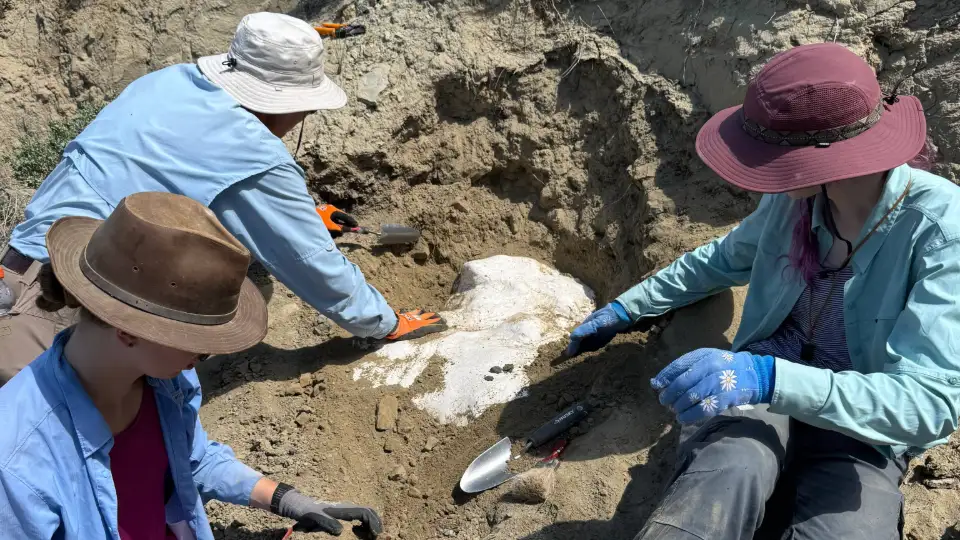
Every summer, our Paleontology Department treks to the Hell Creek Formation in Montana to uncover new fossils — and new insights — to add to our museum’s collections. For eight days this July, Paleontology team members and volunteers axed, shoveled, brushed and cut through layers of dirt to dig up previous year’s plaster-protected fossils and uncover new specimens to preserve for further excavation in future digs.

Up Hell Creek
The Hell Creek Formation is an intensively studied division of mostly Upper Cretaceous and some lower Paleocene rocks in North America. The formation stretches over portions of Montana, North Dakota, South Dakota, and Wyoming. While the upper portion of Hell Creek has been worked extensively, yielding the icons T.rex and Triceratops, the lower part is relatively unexplored. This nearly untouched earth has extreme potential for new discoveries, including ancestors of some of the area’s better-known life.
We asked Dr. Alex Hastings, Fitzpatrick Chair of Paleontology, to give us his expert recap of the trip.

Field Notes from Dr. Alex Hastings
Dr. Hastings: “This summer, the Science Museum of Minnesota Paleontology Team excavated approximately 1.3 meters of overlying matrix from the stratigraphy above a fossiliferous layer of the Hell Creek Formation in central Montana. The fossiliferous layer is from the lowermost section of the formation, placing its geologic date close to 68 million years ago. This site has yielded members of Ceratopsidae (likely Chasmosaurinae), Hadrosauridae (likely Saurolophinae) and Ornithomimidae. The team has also recovered at least one costal element that may pertain to Mammalia. A field jacket was transported by the team, which contains a ceratopsid vertebra, a hadrosaurid vertebra, an ossified tendon and potential cranial material as well. Another field jacket was prepared, which likely contains pelvic and costal material from an ornithomimid dinosaur. Additional skeletal elements were found but could not be recovered before the end of the dig, so these were secured in yet another field jacket and retained at the site. We replaced the ex situ matrix above this material as well as across the rest of the site, in order to more closely align it with the condition prior to excavation. The team is confident that any erosional processes that may occur in the intervening year before the next season will be minimal and recovery of this material will be successful.”

Break it Down, Bite-Sized:
This summer, the museum paleontologists dug up fossils in central Montana in a rock unit called the Hell Creek Formation. They dug through 4 feet of dirt and rock above where fossils were found. This fossil layer is about 68 million years old. At this dig site, the team has found fossils from different kinds of dinosaurs. These include horned dinosaurs like Triceratops, duck-billed dinosaurs like Edmontosaurus, and ostrich-like dinosaurs called ornithomimids. They also found a piece of rib bone that might belong to an early mammal. The team covered some of the bones in hard cases made of plaster — called field jackets — to protect them. They took these jackets back with them to the museum to study. One jacket has a horned dinosaur backbone, a duck-billed dinosaur backbone, a tendon, and some pieces that might be part of a dinosaur’s skull. Another jacket has what are likely hip and rib bones from an ostrich-like dinosaur. There were more bones found, but they didn’t have time to dig them all up. So they covered them to keep them safe for next year. Before leaving, the team put back the dirt and rock they had moved, so the site would look as it did before. They think the bones will be safe from weather until they can come back and continue digging next season.
Stay tuned for more Bite-Sized Science on the Microscope.