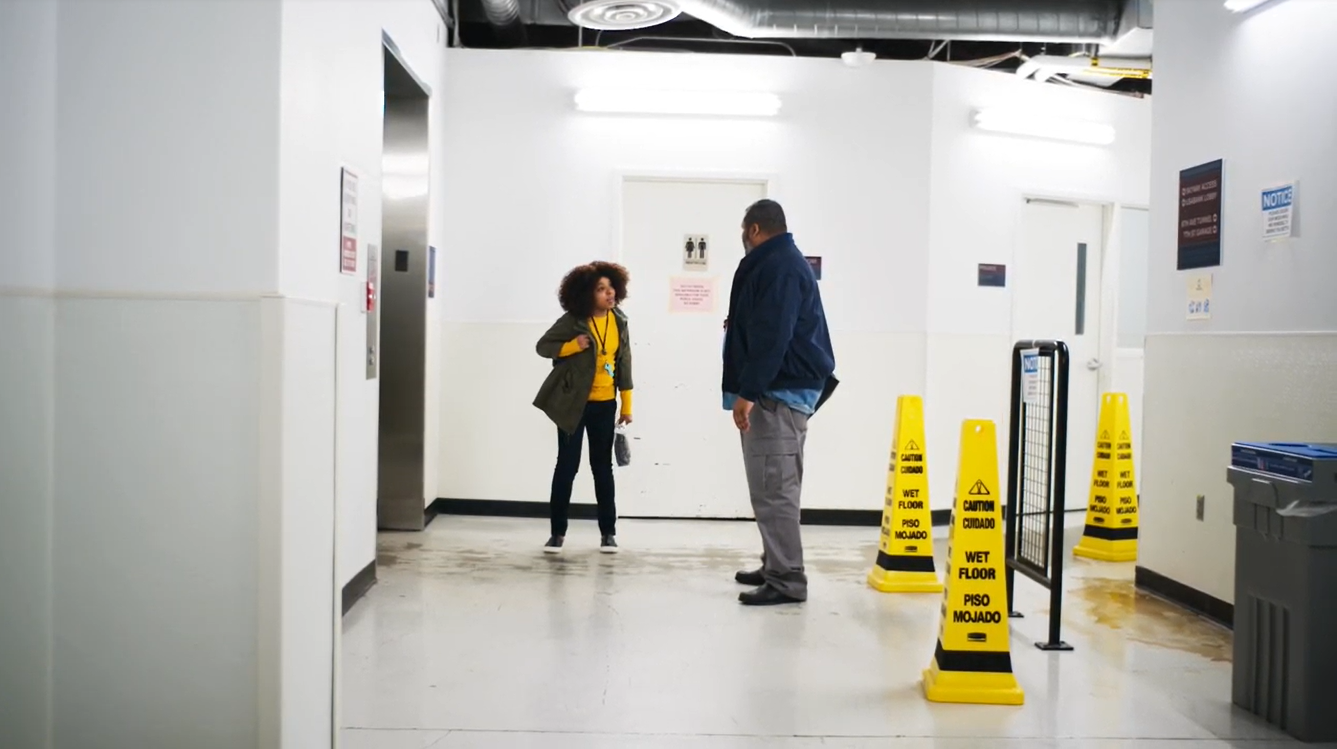
This video and ensuing discussion prompts accompany our exhibit Race: Are We So Different?
Not showing up to school with regularity can have long-term consequences. Watch as Maya runs into her teacher, Joe, who failed her for not showing up to class. Their heated discussion about why he failed her and what that means to both of them brings up how income, identity, and other factors impact education outcomes and ultimately, peoples’ lives.
Have Your Own Conversation
The questions below pair with the video and will prompt you to explore the topics Maya and Joe talk about.
What do you think happened to Maya to be absent from school?
Further reflection: “Working Black students contributed a greater percentage of their earnings to meet family expenses than did White students; higher percentages of Black students reported spending ‘some,’ ‘about half,’ and ‘all or almost all’ of their earnings on family expenses.” (Digest of Education Statistics, Institute of Educational Sciences, U.S. Department of Education, 2005.) How did the educational system fail Maya? Can you think of examples of how it fails other students?
The video is titled Truant. What image comes to your mind when you hear the word “truant”? Does that image tell the whole story? If not, expand on why.
Further reflection: Minnesota law labels students who miss 14 or more days of school as a truant and legal consequences can include juvenile court proceedings, loss of driving privileges, and being removed from their guardians. What are some possible effects of this labeling and criminalization of missing school?
Joe says, “I came up through the same system as you, and I came back to help students like us navigate a school system led by whites….I didn’t build the system, I work it.” What do you think Joe’s experiences have been like in the education system.
Further reflection: “Only 5% of part-time and full-time teachers are people of color in Minnesota.” (Story by Faiza Mahamud and MaryJo Webster, Star Tribune, 2007.) Why is it important for students of color to see representation in the teaching staff?
In what ways does race exacerbate the disparities in our educational system?
Further reflection: “Students of color are often concentrated in schools with fewer resources. Schools with 90 percent or more students of color spend $733 less per student per year than schools with 90 percent or more students.” (UNFC, 2012.) What responsibilities do communities and individuals have to address inequities in our school system?
White individuals are complicit in inequities that exist in education. Actions such as White flight, splinter districting, and school secession all result in school segregation. What are some other examples of inequity from Truant? What are other examples from your experiences in education?
Further reflection: 83.2% of Minnesota high school seniors graduated in 2018. However, Minnesota has the largest racial disparity gap in the country with Black students’ graduation rate at 67% and Native Americans with a 67% graduation rate. (Minnesota Department of Education, 2018.)
Resources
Why are all the Black Kids Sitting Together in the Cafeteria And Other Conversations About Race? by Beverly Daniel Tatum
Other People’s Children by Lisa Delpit
Grading for Equity by Lisa Delpit
Race and Achievement among African American Youth by Na’ilah Suad Nasir
Nice White Parents by the New York Times